


Mindfulness is a proven method to improve focus and reduce distractions. Studies show that practicing mindfulness enhances sustained attention, strengthens mental control, and helps with task switching. Even short daily sessions - just 5–10 minutes - can boost accuracy, reduce stress, and improve workplace performance. For example, a 2025 meta-analysis of 16,054 participants found mindfulness programs significantly improved task performance. Quick mindfulness tools and structured programs make mindfulness accessible for busy professionals, helping to combat workplace stress and increase productivity.
Key Takeaways:
- Mindfulness reduces mind-wandering and strengthens focus.
- Short, consistent sessions (5–10 minutes daily) are effective.
- Digital tools like mindfulness apps make practice convenient.
- Workplace studies confirm better focus, reduced stress, and improved job satisfaction.
Mindfulness is an easy-to-implement strategy for enhancing attention and mental clarity in today’s fast-paced environments.
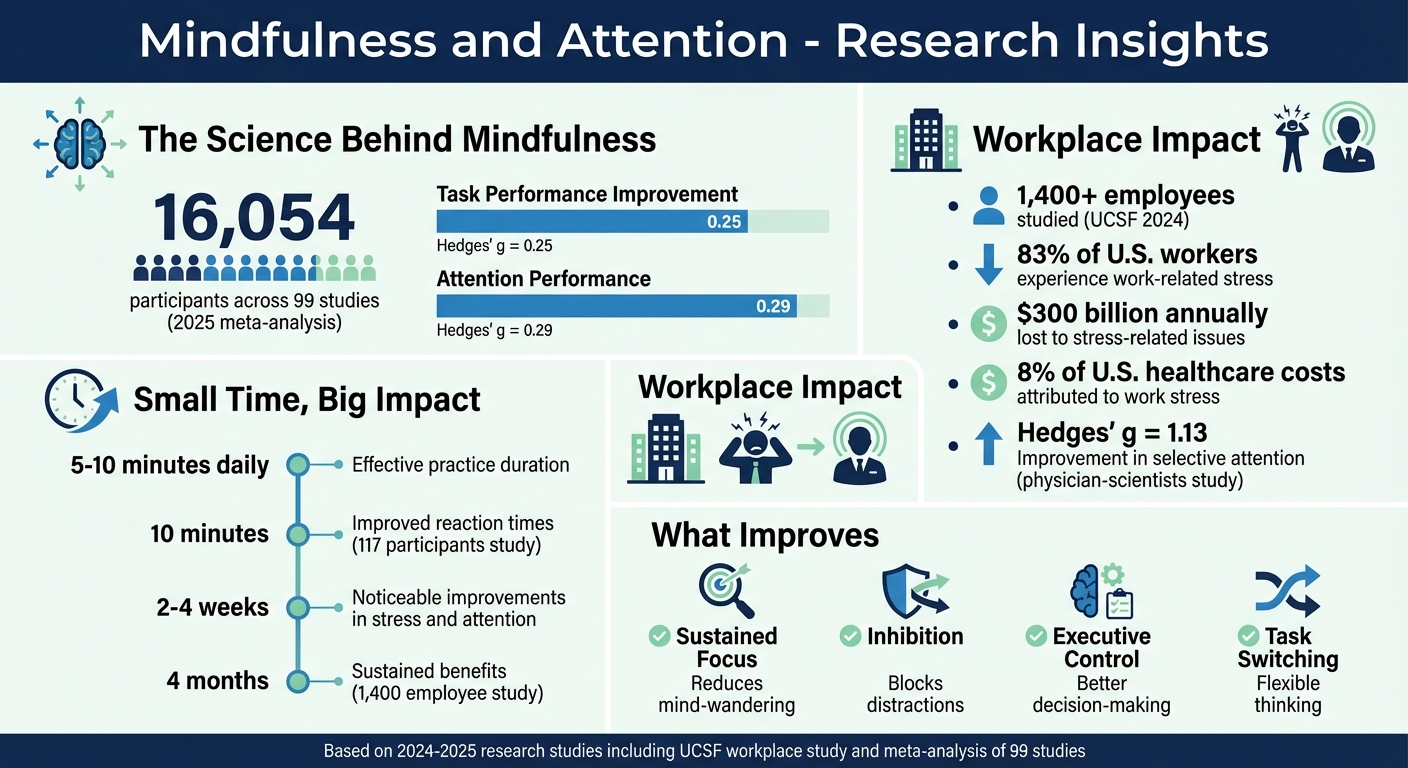
Mindfulness and Attention: Key Research Statistics and Benefits
Research Findings: Mindfulness and Attention
What Systematic Reviews and Studies Show
The connection between mindfulness and improved attention is backed by solid evidence. A 2025 meta-analysis of 99 studies, covering 16,054 participants, revealed that mindfulness-based programs significantly boosted task performance, with an effect size of Hedges' g = 0.25. These results were not only statistically significant but also meaningful in real-world applications.
On average, general mindfulness interventions showed an effect size of Hedges' g = 0.29 for attention performance. The most notable improvements were observed in areas like inhibition and executive control - skills crucial for managing distractions and staying focused. Interestingly, mindfulness training tends to enhance accuracy more than speed, helping individuals make fewer mistakes without necessarily increasing their pace.
Even brief mindfulness practices can yield noticeable benefits. For instance, a September 2025 study from the University of Lancashire involved 117 participants who practiced mindfulness for just 10 minutes. This group demonstrated quicker reaction times and fewer task-unrelated thoughts during attention tests compared to a control group.
Surprisingly, long-term meditation doesn't always deliver extra advantages over shorter programs. While experienced meditators outperformed beginners (effect size g = 0.32), short-term, well-structured interventions often produced comparable cognitive benefits. The key factor appears to be consistency - the frequency of sessions matters more than their duration.
These findings provide a foundation for exploring how mindfulness benefits can extend to professional environments.
Workplace Studies: Results from Mindfulness Programs
Research in workplace settings mirrors the results seen in controlled studies. In January 2024, a University of California, San Francisco (UCSF) study examined over 1,400 employees who participated in daily digital mindfulness practices. Employees who meditated for at least 5 minutes a day reported significant boosts in job satisfaction, engagement, and overall well-being. These improvements, including reduced burnout and anxiety, persisted for four months.
Rachel Radin, PhD, a psychologist and assistant professor at UCSF, highlighted:
"This study confirms prior findings indicating psychological benefits of mindfulness practice for employees and extends them to a digital platform."
Her colleague, Aric Prather, PhD, added:
"Digital mindfulness appears to be a low-cost, low-burden way of improving employee health at scale."
Mindfulness also shifts employees' perspectives on work. Instead of seeing challenging tasks as threats, many begin to view them as opportunities - a subtle but critical change that helps prevent stress from spiraling out of control while preserving mental energy for productivity. This is particularly relevant given that about 83% of U.S. workers experience work-related stress, costing businesses up to $300 billion annually due to absenteeism, turnover, and lost productivity.
These workplace findings underscore mindfulness as a practical tool for improving both attention and job performance.
Additional Benefits of Mindfulness
Mindfulness offers more than just enhanced attention - it also supports overall cognitive and emotional health.
By reducing emotional exhaustion, mindfulness indirectly sharpens focus. It strengthens "meta-awareness", the ability to notice early signs of mental fatigue or distraction before they disrupt productivity. This self-monitoring skill allows individuals to course-correct quickly when their focus begins to waver.
Lower stress levels improve clarity and decision-making, creating a positive cycle that enhances attention and fosters stronger workplace relationships.
sbb-itb-bea8dce
How Mindfulness Works: Brain and Cognitive Processes
Changes in Brain Networks
Mindfulness reshapes the way the brain manages attention by strengthening three key functions: alerting (maintaining vigilance), orienting (deciding what to focus on), and executive control (filtering out distractions). These changes are linked to increased functional connectivity between the Posterior Cingulate Cortex (PCC) - a part of the brain's Default Mode Network active during mind-wandering - and the Dorsolateral Prefrontal Cortex (DLPFC), which governs executive attention. Additionally, mindfulness boosts white matter integrity in the right uncinate fasciculus, improving communication between the hippocampus and frontal brain regions. This enhanced connectivity allows for better regulation of wandering thoughts.
Experienced meditators demonstrate stronger inhibitory activity in the DLPFC, which actively suppresses internal distractions and reduces mind-wandering. Mindfulness also shortens the time spent dwelling on past events, enabling a sharper focus on the present. A study published in PNAS highlighted this:
"Shorter timescales characterize quickly discontinuing past processing to focalize the present moment".
These neural improvements set the stage for the cognitive benefits discussed below.
Cognitive Processes Behind Better Attention
These brain changes translate into better attention by training the mind to quickly recognize distractions and refocus on the task at hand. This practice strengthens neural pathways that support sustained concentration and boosts inhibitory control - the ability to block out irrelevant stimuli and zero in on what matters.
The Capacity-Efficiency Mindfulness (CEM) framework offers a useful perspective: mindfulness doesn't increase overall mental capacity but makes existing resources more effective. A Nature Reviews Psychology study explains:
"Mindfulness training modulates cognitive function by minimizing cognitive–affective interference during task performance, rather than by increasing overall cognitive resources".
By reducing mind-wandering and negative emotions - often referred to as "internal noise" - mindfulness frees up mental energy for complex tasks. Even short-term practice can yield noticeable results. For example, a 31-day online mindfulness program improved reaction times during attention tests among 118 participants.
Stress Reduction and Mental Resources
Mindfulness also helps conserve mental resources by reducing stress. Chronic stress drains mental energy as the brain constantly manages emotional responses. Prolonged stress can elevate cortisol levels, which may shrink hippocampal volume and impair both attention and memory. Mindfulness counters this by encouraging a non-reactive stance toward stressors, reducing the mental effort required to handle challenging situations.
A compelling example comes from a study conducted by the University of California San Diego Medical Scientist Training Program between October 2021 and June 2022. Forty-three physician-scientists, who were at high risk of burnout, participated in three 1.5-hour online mindfulness sessions over 12 weeks. The results showed significant improvements in selective attention (Hedges' g = 1.13). Participants also demonstrated reduced visual alpha oscillations - a neural marker for distractibility - enabling them to filter out irrelevant stimuli and reserve mental energy for demanding tasks. This shows how mindfulness can act as both a preventive measure and a recovery tool, helping to maintain productivity and mental clarity under stress.
Mindfulness Impacts Your Brain & Business | Dr. Amishi Jha | Talks at Google
Applying Mindfulness at Work
Mindfulness techniques can be a game-changer for professionals looking to improve focus and manage workplace stress more effectively.
Mindfulness Practices for Better Focus
One of the simplest and most effective practices is breath-focused meditation. By concentrating on your breathing, you train your mind to stay anchored to a single point, reducing distractions and improving focus. Even a few minutes of this practice before starting your workday can set the tone for better concentration.
Body scans are another helpful technique, where you systematically focus on sensations throughout your body, from head to toe. This can heighten your awareness of physical tension or discomfort, making it easier to address these issues before they disrupt your day. It’s especially useful after long meetings or periods of intense work.
Open-monitoring mindfulness, on the other hand, involves observing all your present experiences - thoughts, sounds, and sensations - without judgment. This approach can help you stay adaptable in fast-paced environments by improving your ability to switch tasks and think flexibly. For quick stress relief, grounding techniques like paying attention to the feeling of your feet on the floor or the sounds around you can calm your nerves during high-pressure moments.
These practices are simple yet powerful tools that can easily fit into your daily routine.
Program Structure and Practice Duration
Consistency is key when it comes to mindfulness. You don’t need to dedicate hours each day - a daily practice of just 5 minutes can significantly lower stress levels. For example, employees who meditate for 5 to 10 minutes a day have shown measurable reductions in stress, with a notable drop in Perceived Stress Scale (PSS) scores (–6.58).
Structured programs often run for 8 weeks, with daily sessions lasting 7 to 12 minutes. Research from institutions like the University of Tokyo and a U.S. academic center highlights the effectiveness of this approach, showing reduced stress and improved job engagement over time .
For those with packed schedules, micro-practices are a practical alternative. These involve taking 1-to-2-minute mindfulness breaks throughout the day - before meetings, at the top of each hour, or between tasks. Considering the average person spends nearly half their waking hours distracted, these short pauses can help you stay present and focused.
Using Digital Tools for Mindfulness
Digital tools make it easier than ever to incorporate mindfulness into your workday. Apps like The Mindfulness App offer guided meditations, sleep aids, and mindfulness courses that you can access anytime, anywhere. With over 500 tracks available in 12 languages and offline functionality, these tools are perfect for busy professionals. Whether you’re commuting, taking a lunch break, or winding down after work, these apps provide the flexibility to practice on your terms.
Beyond personal benefits, digital tools can also support organizational wellness. They provide consistent, high-quality mindfulness instruction across teams, regardless of location. Given that work-related stress accounts for about 8% of U.S. healthcare costs, investing in these tools isn’t just good for employee well-being - it’s also a smart business decision.
Conclusion: Main Findings and Next Steps
Summary of Research Findings
Recent studies highlight how mindfulness improves attention by enhancing four key components: sustained focus, resistance to distractions, attentional control, and the ability to switch tasks flexibly. This is achieved by reducing "cognitive-affective interference", which helps minimize the effects of mind-wandering and negative emotions. Beyond sharpening focus, mindfulness has been shown to reduce workplace stress, lower burnout, and increase job engagement. These benefits often persist for months after initial training. Even short daily sessions of just 5–10 minutes can lead to noticeable improvements in stress levels and attention within 2–4 weeks. Digital tools are making it easier than ever for busy professionals to access these practices.
Research Gaps and Future Questions
While the findings are encouraging, there are still some unanswered questions. Many studies have used wait-listed control groups instead of active comparison groups, making it harder to separate the true effects of mindfulness from possible placebo responses. Ruchika Shaurya Prakash from The Ohio State University emphasizes this issue:
"Critically, inclusion of active comparison groups and explicit attention to the reduction of demand characteristics are needed to disentangle the effects of placebo from treatment".
Another area that needs exploration is determining the right "dose" of meditation for different individuals and workplace settings. David Ziegler from UCSF's Neuroscape team points out:
"The biggest challenges in this work is determining who responds to meditation and how much of a 'dose' someone needs to reap the benefit".
While short mindfulness sessions improve basic attentional tasks, their impact on more complex tasks requiring creative or convergent thinking remains unclear. Addressing these gaps will help refine mindfulness practices and improve their effectiveness in workplace environments.
Recommendations for U.S. Workplaces
To build on these insights and address research gaps, U.S. workplaces can take actionable steps to integrate mindfulness into their routines. Start by using digital platforms that employees can access anytime. A January 2025 UCSF study found that daily app-based mindfulness sessions significantly reduced burnout and improved work engagement over an eight-week period. Encourage employees to practice mindfulness for 10–15 minutes daily rather than relying on occasional longer sessions. Incorporating "micro-breaks" during natural pauses in the workday - especially during high-stress moments - can also be effective.
Tracking measurable outcomes like task completion rates, error reduction, or team collaboration improvements can provide a clearer picture of mindfulness programs' impact, rather than relying solely on employee feedback surveys. Considering that work-related stress contributes to approximately 8% of U.S. healthcare costs, implementing evidence-based mindfulness programs could benefit both employees and company budgets.
Digital mindfulness tools offer a simple way to make these practices part of employees' daily routines. For example, The Mindfulness App provides guided meditations and courses designed to help users manage stress, improve focus, and foster personal growth in the workplace. By adopting such tools, organizations can create healthier, more engaged, and productive work environments.
FAQs
How soon will I notice better focus from mindfulness?
Research indicates that practicing mindfulness regularly can sharpen focus in as little as 30 days. Studies have found that it helps improve attentional control and minimizes distractions, with many people noticing these effects within a few weeks. Dedicating just 10–12 minutes a day to mindfulness exercises can make a difference. Using mindfulness apps can also be a helpful way to stay on track and monitor your progress.
Is 5–10 minutes a day really enough to improve attention?
Yes, research indicates that dedicating just 5–10 minutes a day to mindfulness practice can noticeably improve attention and focus. These brief but regular sessions help your mind stay anchored in the present, gradually boosting mental clarity and your ability to concentrate.
What mindfulness practice is best for staying focused at work?
Focused attention meditation is a practical way to sharpen your focus at work. It’s all about directing your attention to one thing - like your breath or a specific sound - and calmly guiding your mind back when it starts to wander. This simple yet powerful practice helps you stay present, cut through distractions, and boost productivity on the job.