

Meditation is a simple yet effective way to improve your focus and mental clarity. By training your mind to stay present, it strengthens the brain's ability to concentrate, reduces stress, and even reshapes areas responsible for attention and self-control. Here's what you need to know:
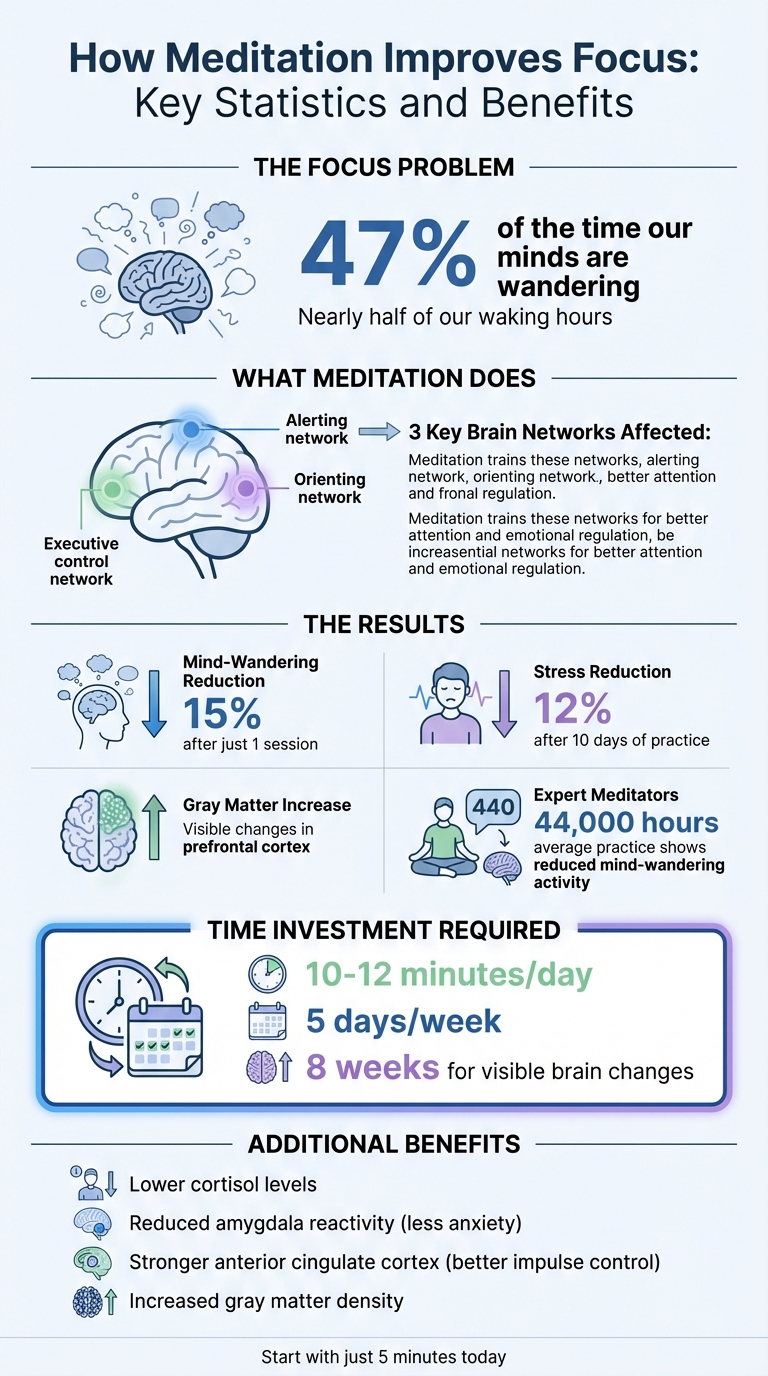
- Focus Benefits: Meditation helps reduce mind-wandering (which happens 47% of the time) and improves your ability to return to tasks after distractions.
- Stress Reduction: Regular practice lowers cortisol levels and calms the amygdala, reducing anxiety and improving focus.
- Brain Changes: Meditation strengthens neural pathways and increases gray matter in areas linked to attention and memory.
- Short Practice Needed: Just 10–12 minutes a day, five days a week, can lead to noticeable improvements in focus and mental resilience.
Starting small, using techniques like mindfulness or breath counting, and staying consistent can help you build a meditation habit. Tools like meditation apps can guide your practice and track your progress. Ready to focus better? Start with just a few minutes today.
How Meditation Improves Focus: Key Statistics and Brain Benefits
The Science Behind Meditation and Focus
Effects on the Brain's Attention Networks
Meditation has a profound impact on the brain's ability to focus by working with its three attention networks: alerting, orienting, and executive control. These networks manage how we direct and sustain our attention.
Through meditation, the brain's salience network - which identifies distractions - becomes more active, helping the executive network redirect attention. At the same time, meditation reduces activity in the default mode network, which is often linked to mind-wandering. This combination not only sharpens focus but also equips the brain to handle stress more effectively, a key factor in staying attentive.
For example, a 16-week study involving 28 beginners practicing meditation for 10 minutes daily showed clear improvements in attentional control during a Stroop task. As Peter Malinowski explained:
"Mindfulness meditation practice appears to positively impact attentional functions by improving resource allocation processes".
Meditation doesn't just change how the brain works - it also changes its structure. Studies have shown that meditation increases gray matter density and cortical thickness in the prefrontal cortex and anterior cingulate cortex, areas essential for focus. Remarkably, expert meditators with an average of 44,000 hours of practice demonstrate reduced activity in regions tied to wandering thoughts, signaling greater neural efficiency. Even short daily sessions - just 30 minutes - can lead to visible changes in brain activity.
Lower Stress and Cortisol Levels
Stress is one of the biggest barriers to focus, and meditation helps tackle this directly by reducing cortisol, the hormone associated with stress. When cortisol levels drop, the brain can devote more energy to maintaining attention.
A 2007 study involving 40 undergraduates found that five days of practicing Integrative Body-Mind Training (IBMT) for 20 minutes per day significantly reduced cortisol levels and improved their ability to resolve conflicts.
Meditation also influences the amygdala, the part of the brain responsible for processing fear and anxiety. Research shows that meditation can shrink the amygdala and reduce its reactivity, helping to quiet the "fight or flight" response. At the same time, it strengthens the anterior cingulate cortex, which plays a critical role in focus, impulse control, and resolving mental conflicts. This dual effect creates an environment in the brain that supports sustained attention and calm concentration.
Meditation Techniques That Improve Focus
Mindfulness Meditation
Think of your attention like a muscle - it gets stronger with regular exercise. Mindfulness meditation is one way to build that strength. The process is straightforward: focus on an anchor (like your breath), notice when your thoughts wander, and gently bring your attention back to that anchor. It’s not about stopping thoughts but about learning to notice distractions and choosing where to direct your focus deliberately.
Rich Fernandez, former CEO of the Search Inside Yourself Leadership Institute, explains it well:
"Being able to exercise focused attention simply means being able to direct your attention, becoming aware if your mind has wandered, and then being able to redirect your focus".
Start small - just 5 to 10 minutes a day - and gradually work your way up to around 12 minutes as your ability to focus improves. Use a physical sensation, like the feeling of air passing through your nostrils or the rise and fall of your chest, as your anchor. It’s natural for your mind to wander (research suggests this happens about 47% to 50% of the time), but the key is to gently bring your focus back each time. Practicing mindfulness for 12 minutes a day, five days a week, has been shown to strengthen and protect your attention span. If you prefer more structure, the breath counting technique might be a good next step.
Breath Counting Technique
If focusing solely on your breath feels tricky, adding a counting element can help. This method gives your mind a specific task, making it easier to catch yourself when your focus drifts.
Here’s how it works: breathe naturally and count each exhale, starting at one and going up to ten. Once you reach ten, start over. If you lose track, don’t worry - just calmly begin again at one. This practice sharpens your ability to notice distractions and helps cultivate a steady, intentional focus. Over time, it encourages a shift from reacting impulsively to responding with awareness. If you’re curious about another approach, Transcendental Meditation offers a different way to enhance focus.
Transcendental Meditation

Transcendental Meditation (TM) takes a slightly different path to focus. Instead of anchoring your attention to your breath or counting, TM uses a personalized mantra - a specific word or sound you repeat silently. This mantra helps calm your mind and create a relaxed yet alert state. Unlike mindfulness meditation, which emphasizes staying present, TM allows you to settle into a tranquil mental space while gently refocusing on your mantra whenever distractions arise. It’s a complementary technique that promotes both relaxation and concentration.
Building a Regular Meditation Practice
Setting Realistic Goals and Schedules
Start small - just 1 to 5 minutes a day is enough to establish a meditation habit. Research backs this up: a single meditation session can reduce mind-wandering by 15%, and practicing daily for 10 days can lower stress levels by 12%. The secret lies in showing up consistently. Even a few minutes every day can have a bigger impact than an occasional, lengthy session.
Treat meditation as a must-do appointment. Carve out a specific time each day and stick to it. Pairing meditation with an existing habit - like after brushing your teeth or sipping your morning coffee - can help it blend seamlessly into your routine. This "habit stacking" technique makes it easier to stay consistent.
Sharon Salzberg, a renowned meditation teacher, emphasizes the importance of simply starting:
"The most important moment in your meditation practice is the moment you sit down to do it. Because right then you're saying to yourself that you believe in change, you believe in caring for yourself, and you're making it real".
Stick with it, and after about eight weeks, you'll see real changes. Studies show that regular meditation can physically rebuild grey matter in the brain, which is crucial for cognitive functions and processing information.
Combining Meditation with Healthy Lifestyle Habits
Meditation becomes even more effective when paired with other healthy habits. Getting 7–9 hours of sleep, staying hydrated, and exercising regularly can amplify the benefits of your practice. For instance, physical activity releases endorphins, which can enhance your meditation experience, while good sleep supports the neural changes sparked by regular practice.
You can also incorporate mindfulness into your daily workflow. Techniques like the Pomodoro method - working in focused sprints - can boost productivity by up to 43% for some teams. Reducing digital distractions, like limiting social media or batching email checks, helps minimize interruptions, allowing you to maintain focus throughout the day. Creating a dedicated meditation space, even if it’s just a small corner or a specific chair, signals to your brain that it’s time to unwind and focus.
Using Tools Like The Mindfulness App

Apps like The Mindfulness App can be game-changers for building a consistent meditation routine. They offer guided meditations and structured programs such as "7 Days of Focus" or "Deep Concentration". These programs take the guesswork out of meditation, providing a clear path to improve attention and focus.
Features like daily check-ins, personalized plans, and reminders help turn meditation into a daily habit. The app even tracks your progress, so you can see how your focus improves over time - a great motivator. With over 500 exclusive tracks available in multiple languages, you can explore techniques like breath awareness, body scans, or loving-kindness meditation to find what works best for you. Plus, the app’s 14-day free trial lets you experiment with different styles risk-free, making it easier to dive in and stick with it.
sbb-itb-bea8dce
Mindfulness Guided Meditation for Focus
Conclusion
Meditation helps train your brain to notice when it drifts off and gently bring it back to the present. With regular practice, it strengthens the neural pathways responsible for focus, reduces cortisol levels, and even reshapes parts of the brain linked to attention and self-control.
You don’t need hours - just 10 minutes a day can make a difference. Right now, your mind might wander nearly half the time (about 47%). But with consistency, you’ll get better at catching those distractions and refocusing. Think of it like exercising a muscle - each time you redirect your attention, you’re building strength.
Meditation doesn’t just sharpen focus; it also boosts overall well-being. It can improve sleep, lower blood pressure, enhance emotional balance, and even make problem-solving easier. As Yi-Yuan Tang, a neuroscientist at Texas Tech, explains:
Mindfulness meditation has been shown to cause distinct changes in brain structure and brain function.
These changes set the stage for a more productive and balanced life. All it takes is choosing a time, focusing on something simple like your breath, and sticking with it daily for 10 minutes. Progress might feel slow, but every time you guide your wandering mind back, you’re making strides that add up over time.
If you’re ready to start, tools like The Mindfulness App can help. It offers a 14-day free trial with over 500 guided meditations and programs like "7 Days of Focus" to support your journey and track your progress. Your future self - calm, focused, and more resilient - starts with this small, intentional step.
FAQs
How does meditation help improve focus and concentration?
Meditation helps sharpen focus by teaching your brain to stay in the moment and ignore distractions. By consistently returning your attention to one thing - whether it's your breath, a sound, or a sensation - you gradually improve your ability to concentrate for longer stretches of time.
It also strengthens your ability to bounce back from distractions. Each time your mind drifts and you gently bring it back, you're training yourself to handle interruptions more smoothly. On top of that, meditation soothes the stress response, easing anxiety and clearing mental clutter that often disrupts focus.
If you're just starting out, guided meditations - like those available through The Mindfulness App - can make the process easier. Even short, focused sessions can help you tap into these benefits, making meditation approachable and effective for beginners.
What are the best meditation techniques for beginners to improve focus?
Meditation is an excellent way to sharpen your focus, especially if you're just starting out. One of the easiest techniques to try is focused attention meditation. This involves concentrating on a single point - like your breath, a candle flame, or even a soothing word. When your mind inevitably wanders, you simply guide it back to your focus, helping to strengthen your attention and mental clarity over time.
Here are a few beginner-friendly methods to get you started:
- Breath-focused meditation: Sit in a comfortable position with your eyes closed and focus on counting your breaths. If your mind starts to wander, gently bring your attention back to your breathing.
- Object-focused meditation: Choose a small object, such as a candle, and focus on its details - its shape, color, or the way it moves. Each time your thoughts drift, return your focus to the object.
- Mantra meditation: Pick a calming word or phrase, like "peace", and silently repeat it with each breath. Let this word serve as your anchor to keep your attention steady.
For a little extra help, you can try guided meditations through tools like The Mindfulness App. It's designed with beginners in mind, offering short, simple sessions to ease you into the practice. Even dedicating just a few minutes a day can lead to noticeable improvements in your focus and clarity.
How soon can meditation help improve focus?
Many individuals find that their focus improves significantly after just one meditation session. Dedicating even 10 minutes a day to meditation can create noticeable changes. Over time, with consistent practice, these benefits tend to grow, making it easier to stay present and focused on everyday tasks.
The secret lies in building a routine. Making meditation a regular part of your day can lead to lasting gains in concentration and mental clarity. If you're just starting out, guided meditations can be a great way to ease into the practice and build the habit.