


Mindfulness can help you stop procrastinating. Here’s why:
- Procrastination is emotional: It happens when you avoid tasks because they feel boring, stressful, or overwhelming. Instead of tackling them, you seek short-term comfort, which hurts your productivity and well-being.
- Mindfulness improves focus and emotional control: By observing your thoughts and emotions without reacting, mindfulness helps you manage feelings like anxiety or boredom. This makes it easier to stay on task.
- It boosts energy and resilience: Studies show mindfulness increases "learning vigor" - the mental energy needed to handle tough tasks.
- Science backs it up: Research proves mindfulness training reduces procrastination across different age groups, from college students to middle schoolers.
Simple practices like breathing exercises, body scans, and guided meditations can help you build focus and self-discipline over time. Even 5 minutes a day can make a difference.
Perfectionism, Procrastination, and Mindfulness
sbb-itb-bea8dce
The Science Behind Mindfulness and Procrastination
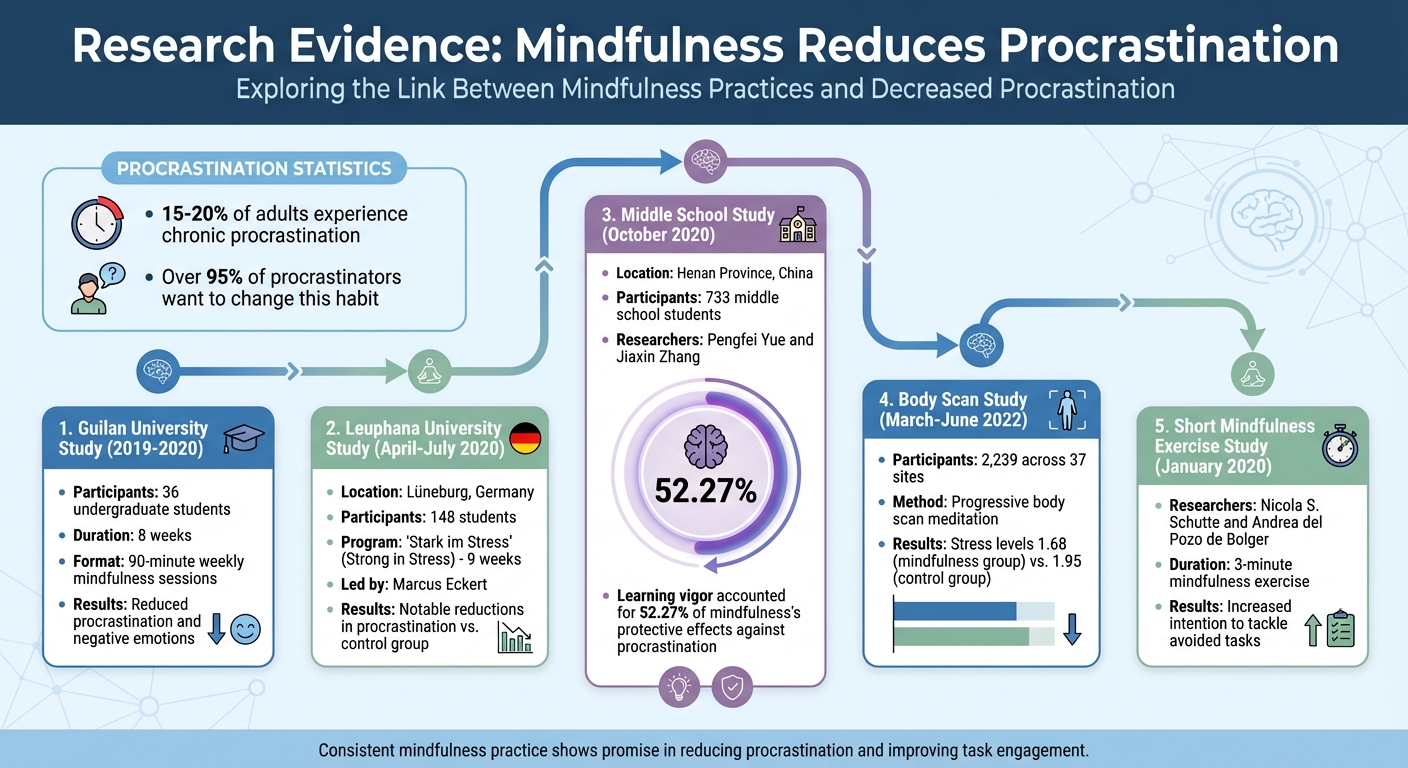
How Mindfulness Reduces Procrastination: Research Statistics and Key Studies
Recognizing Avoidance Behaviors Through Mindfulness
Procrastination often arises from what experts call "task aversiveness" - the tendency to avoid tasks that feel boring, challenging, or anxiety-inducing. Mindfulness helps break this cycle by encouraging you to see thoughts and emotions as temporary. The concept of meta-awareness, or the ability to observe your own avoidance tendencies, plays a crucial role here. For example, when you catch yourself wanting to scroll through your phone instead of working, mindfulness creates a pause, giving you the chance to refocus. As highlighted in research published in Frontiers in Psychology, "Individuals with high mindfulness levels observe the contents of their consciousness more objectively... they demonstrate greater tolerance for unpleasant internal states, such as boredom during learning, thereby reducing the urge to engage in avoidance behaviors".
This self-awareness lays the groundwork for better emotional regulation.
Better Emotional Regulation Through Mindfulness
At its heart, procrastination often stems from emotional mismanagement. When faced with a stressful task, your brain may prioritize quick relief - like distractions - over long-term goals. This is known as immediate mood regulation. Mindfulness helps counter this by building resilience to uncomfortable emotions, reducing the need to escape. Studies suggest that individuals with lower mindfulness levels often struggle to regulate their emotions, which can fuel procrastination. By fostering awareness and acceptance, mindfulness helps you recognize the emotions behind your procrastination, whether it’s fear of failure, boredom, or anxiety.
The numbers speak for themselves: between 15% and 20% of adults deal with chronic procrastination, and over 95% want to change this habit. Mindfulness reduces negative thought patterns and automatic responses, offering a practical way to break free from the procrastination loop.
Research further supports these mindfulness benefits.
Research Study: Mindfulness Training Reduces Procrastination
Multiple studies confirm that mindfulness training can significantly reduce procrastination. For instance, a study conducted at Guilan University during 2019–2020 involved an eight-week program with 90-minute weekly mindfulness sessions. Among 36 undergraduate participants, the program reduced both procrastination and negative emotions.
In another study at Leuphana University of Lüneburg in Germany (April–July 2020), 148 students participated in a nine-week online program called "Stark im Stress" (Strong in Stress), led by Marcus Eckert. This program combined mindfulness and relaxation exercises to improve emotional regulation. Participants who completed the program showed notable reductions in procrastination compared to a control group.
Perhaps the most striking findings come from a study conducted in October 2020 with 733 middle school students in Henan Province, China. Researchers Pengfei Yue and Jiaxin Zhang discovered that mindfulness significantly reduced academic procrastination. A key factor was increased "learning vigor" - the mental energy and resilience to tackle tough tasks - which accounted for 52.27% of mindfulness's protective effects.
How Mindfulness Improves Self-Regulation
Self-regulation refers to managing your thoughts, emotions, and actions to achieve long-term goals. When self-regulation falters, procrastination often takes over. Mindfulness helps strengthen the mental tools needed to stay on track. This builds on mindfulness's earlier-discussed role in managing emotional challenges and avoidance behaviors.
Staying Focused on the Present Moment
It’s natural for your mind to wander, especially when working on something difficult. You might find yourself thinking about dinner, a funny video, or weekend plans. This mental drifting can lead to procrastination. Mindfulness helps combat this by training your brain to stay anchored in the present.
Research involving 174 participants revealed that sustained attention acts as a key link between mindfulness and reduced procrastination. People who practiced mindfulness were better at focusing on a single task, which directly correlated with procrastination reduction. When your attention remains steady, even complex tasks feel less overwhelming and more achievable.
On a neurological level, mindfulness shifts activity away from the default mode network - responsible for daydreaming and self-focused thoughts - and activates the frontoparietal and attention networks, which support goal-oriented actions.
Even short mindfulness exercises can immediately improve focus and your intention to tackle tasks. For example, if you feel tempted to check your phone or open a new browser tab, a quick breathing exercise can redirect your attention back to what matters.
Beyond improving focus, mindfulness also nurtures the discipline needed to stick with challenging tasks.
Building Self-Discipline and Willpower
Self-discipline isn’t just about forcing yourself to work - it requires mental energy, often referred to as learning vigor. This combination of resilience, energy, and persistence gives you the psychological strength to start tasks, even when they feel tedious or difficult.
Mindfulness helps restore self-control. When you're mentally drained, resisting distractions like social media can feel almost impossible. By fostering a state of non-reactive awareness, mindfulness conserves the mental energy needed to follow through on commitments.
Research highlights how mindfulness builds mental stamina and resilience, which reduces the tendency to avoid tough tasks.
| Self-Regulation Skill | How It Works | Impact on Procrastination |
|---|---|---|
| Attention Control | Keeps focus on current tasks | Minimizes distractions and task avoidance |
| Emotional Regulation | Increases tolerance for discomfort | Reduces avoidance behaviors tied to stress |
| Mental Energy | Recharges depleted willpower | Boosts ability to start and complete difficult tasks |
Mindfulness also enhances autonomous motivation - the feeling that you’re choosing to act because the task aligns with your values, rather than out of obligation. Shifting from external pressure to intrinsic motivation can significantly reduce procrastination. When tasks feel personally meaningful, they become less about duty and more about purpose.
A practical tip: Instead of blaming yourself for lacking willpower, use mindfulness to check in with your energy levels. Recognizing when you’re mentally drained allows you to recharge through mindfulness practices, rather than pushing through with strained self-control.
How to Use Mindfulness to Overcome Procrastination
Research provides the foundation, but it’s the small, targeted mindfulness exercises that help shift habits. These exercises tap into emotional regulation and focus, making them practical tools for overcoming procrastination. Let’s break down how you can incorporate mindfulness into your daily routine.
Simple Mindfulness Practices to Get Started
Here are a few straightforward exercises to help you ease into mindfulness:
- Box breathing is perfect for calming your nerves when anxiety about a task creeps in. Breathe in for four counts, hold for four, exhale for four, and hold again for four. This rhythmic breathing helps create a pause between the impulse to avoid a task and your response.
- The 5-4-3-2-1 grounding technique works by engaging your senses to disrupt anxious thoughts. Identify five things you can see, four you can hear, three you can touch, two you can smell, and one you can taste. This exercise anchors you in the present moment.
- For deeper relaxation, try a progressive body scan. Between March and June 2022, researchers tested this method with 2,239 participants across 37 sites. The results showed that participants who practiced the body scan reported lower stress levels - 1.68 compared to 1.95 in the control group.
Even just five minutes of daily mindfulness practice can help you build self-regulation more effectively than a single 30-minute session once a week. You can easily weave mindfulness into your day by taking a few intentional breaths before checking emails or practicing awareness while brushing your teeth.
Using Guided Meditations for Procrastination
Once you’re comfortable with the basics, guided meditations can help you tackle deeper emotional barriers that lead to procrastination. These meditations focus on addressing the feelings behind task avoidance, rather than simply forcing yourself through the motions.
One key idea in guided meditation is “simply beginning again.” When your mind wanders, the act of noticing and returning to your breath is what meditation teacher Joseph Goldstein calls a "magic moment." It’s a practice of refocusing without judgment.
"The three most important words in mindfulness meditation are 'simply begin again.'"
- Joseph Goldstein, Co-founder, Insight Meditation Society
In a study conducted in January 2020, researchers Nicola S. Schutte and Andrea del Pozo de Bolger found that participants who completed a three-minute mindfulness exercise reported a stronger intention to tackle tasks they had been avoiding .
Apps like The Mindfulness App offer guided meditations specifically designed to enhance focus and reduce stress. With over 500 tracks available in 12 languages, these sessions can help you cultivate the sustained attention needed to combat procrastination.
| Practice | Benefit for Procrastination | Time Needed |
|---|---|---|
| Box Breathing | Calms anxiety tied to tasks | 1–2 minutes |
| Body Scan | Increases awareness; reduces avoidance | 5–20 minutes |
| 5-4-3-2-1 Technique | Interrupts anxious thoughts | 2 minutes |
| Mindful Walking | Combines movement with focus | 5+ minutes |
Creating a Consistent Mindfulness Routine
When it comes to mindfulness, consistency beats intensity. Studies show that short, regular sessions are more effective at improving self-regulation and reducing procrastination than infrequent, longer ones.
Start with the body scan as your go-to exercise. Research highlights it as one of the most effective practices for reducing the stress that often triggers procrastination. Pick a consistent time for it - whether it’s in the morning or during a midday break.
When tackling a task you’d rather avoid, try “reperceiving.” This involves observing your emotions - like boredom or anxiety - without trying to change them. Recognize these feelings as sensations, not commands to avoid the task. This approach builds your tolerance for discomfort, helping you push through resistance.
"Mindfulness is about changing your relationship with your mental and emotional experience."
- Talya Cohen, PsyD
Another strategy is creating a "wait-list buffer." When you feel the urge to procrastinate, pause and do a short mindfulness exercise first. Even brief sessions can increase your motivation to tackle a task. The Mindfulness App’s offline features make it easy to stay consistent, even when life gets hectic.
Conclusion
Key Insights from the Research
The research highlights a compelling connection between mindfulness and self-regulation, showing how mindfulness can play a major role in tackling procrastination. Procrastination isn't about being lazy - it’s tied to struggles with self-control and managing emotions. Mindfulness helps train your brain to better handle the anxiety, frustration, or boredom that often lead to avoiding tasks.
Studies show that mindfulness training not only reduces procrastination but also boosts mental resilience and energy - qualities essential for starting and sticking with tasks.
"Mindfulness training can lead to self-regulation in procrastinators."
Interestingly, the research also points to a two-way relationship: practicing mindfulness reduces procrastination, and overcoming procrastination encourages more mindful behaviors. Together, these effects promote a greater sense of well-being. This makes mindfulness a valuable tool to incorporate into your daily life.
Building Mindfulness into Your Routine
Since procrastination is such a common struggle, making mindfulness part of your daily routine offers a practical and effective way to address it. Even simple practices, like a five-minute breathing exercise or a quick body scan, can help you refocus and take on tasks with greater intention.
Tools like The Mindfulness App, with its extensive library of over 500 guided meditations, mindfulness courses, and sleep stories, make it easier than ever to establish a consistent practice - even without an internet connection. By learning to notice and accept discomfort without judgment, you create the mental clarity needed to break free from the procrastination cycle.
FAQs
How does mindfulness improve emotional regulation to reduce procrastination?
Mindfulness can be a game-changer for emotional regulation. It teaches you to notice your emotions without jumping to react, creating a pause that helps you respond thoughtfully. Procrastination often creeps in when we avoid tasks to dodge feelings like anxiety or frustration. Mindfulness steps in by breaking this pattern, encouraging you to acknowledge and accept your emotions, which makes tackling tasks feel less overwhelming.
Studies have found that mindfulness training boosts self-regulation, cuts down on procrastination, and sharpens focus. How? By teaching practical skills like identifying your emotions, staying grounded in the present moment, and handling discomfort more effectively. With regular practice, emotional stress becomes something you can navigate, rather than something that derails your progress toward your goals.
If you’re ready to weave mindfulness into your daily life, The Mindfulness App is a great starting point. It offers guided meditations and quick exercises designed to help balance your emotions, ease stress, and keep procrastination at bay - all while supporting your productivity.
What mindfulness techniques can help with procrastination?
Mindfulness techniques can be a game-changer when it comes to overcoming procrastination. By addressing the underlying emotional and mental patterns that lead to delays, these practices can help you take control of your time and tasks.
One effective method is short daily mindfulness meditation. Spending just 5–10 minutes focusing on your breath and gently guiding your mind back when it wanders can build self-discipline and keep you grounded in the present moment. This simple habit can make a noticeable difference in how you approach your to-do list.
Another strategy is to try a focused breathing exercise right before diving into a task. This helps ease anxiety or feelings of being overwhelmed, making it much easier to get started. Pair this with a “begin again” mindset, where you acknowledge any delays without judgment and consciously recommit to the next step. It’s a great way to reset and regain momentum.
For those who want to go deeper, body-scan practices or guided mindfulness courses can be incredibly helpful. These techniques enhance your awareness of physical and emotional discomfort, allowing you to push through distractions and stay on track. If you’re not sure where to start, tools like The Mindfulness App offer guided meditations and resources designed specifically to improve focus and tackle procrastination.
How does mindfulness help improve focus and overcome procrastination?
Mindfulness, which involves being fully present and aware without judgment, has been proven to sharpen focus and cut down on procrastination. Research shows that practicing mindfulness improves attention, boosts mental energy, and helps people face tough tasks with more purpose and persistence. For instance, studies reveal that mindfulness training can lower procrastination by enhancing self-regulation and concentration, even in challenging situations like remote work.
One reason mindfulness works so well is its ability to encourage self-compassion. This reduces the cycle of negative self-talk and mental exhaustion. By staying anchored in the present, people are better equipped to handle stress and maintain the energy needed to tackle demanding tasks. For those looking to put mindfulness into practice, The Mindfulness App provides guided meditations and courses aimed at building focus and sustaining motivation for even the hardest projects.