


Mindfulness can transform how you manage tasks by improving focus, reducing distractions, and helping you work more effectively. Instead of multitasking, mindfulness encourages single-tasking - focusing fully on one task at a time. This approach boosts productivity, reduces errors, and helps you feel less drained at the end of the day.
Here’s how mindfulness can help:
- Increases focus: Mindfulness strengthens the prefrontal cortex, improving attention and decision-making.
- Reduces stress: Techniques like mindful pauses and breathing exercises calm your nervous system.
- Improves productivity: Studies show mindful employees are 12%-20% more productive.
- Encourages single-tasking: Avoid multitasking, which reduces efficiency by up to 40%.
Simple habits like mindful time blocking, setting daily intentions, and using short breaks can make a big difference. Start with small practices, like taking a deep breath before beginning a task or using the Pomodoro Technique for focused work sessions. These steps help you stay present and intentional, leading to better task management and a more balanced workday.

Mindfulness Benefits for Task Management: Key Statistics and Productivity Data
Setting Up Your Mindful Task Management System
Tools and Practices You'll Need
To get started, you'll need a few essentials. First, choose a task management tool that fits your style. Digital options like VirtualSpace can help you organize your to-do list, freeing up mental space so you can focus on what truly matters. Pair this with a time management framework like the Eisenhower Matrix or the 80/20 rule to ensure you're prioritizing tasks that have the biggest impact.
Your physical workspace plays a big role too. A clean, simple setup with calming touches can reduce stress and improve your ability to concentrate. Keep a daily journal nearby for tracking habits and jotting down thoughts. A five-minute timer can also be handy for taking short, mindful breaks [10, 12]. Consider using tools like The Mindfulness App, which offers guided meditations and breathing exercises to help you center yourself before diving into work.
With these tools in place, you're setting the stage for focused, effective task management. A well-organized environment naturally supports the single-tasking approach discussed in the next section.
Why Single-Tasking Beats Multitasking
Despite what many believe, your brain isn't built for multitasking. What feels like juggling tasks is actually task-switching - your brain rapidly shifting focus, which drains both energy and time [16, 17, 20]. Research shows that multitasking can cut productivity by up to 40%. On top of that, after an interruption, it takes an average of 23 minutes and 15 seconds to regain focus. Even minor distractions can lead to more mistakes [19, 22].
On the other hand, single-tasking allows you to enter a flow state - a mental zone where work feels smooth and effortless [16, 21]. This deep focus is essential for meaningful progress. As Keller puts it:
"When you are trying to do two things at once, you either can't or won't do either well".
By dedicating your full attention to one task at a time, you're actively practicing mindfulness through focus and awareness, directly improving your work.
How to Set Daily Intentions
Start your day by setting a clear intention - something like "focus", "calm", or "presence." This simple act helps you prioritize and stay grounded, even when the day gets hectic. Before checking your phone or opening your laptop, spend two minutes observing your breath. This small ritual can reduce the cortisol spike that often comes with waking up.
Think of your intention as your internal guide for the day. When distractions arise or your schedule starts to feel overwhelming, you can return to it as a mental anchor. The goal isn't to be perfect but to create a little space between yourself and automatic reactions, so you can choose where to direct your energy.
Using Mindfulness to Prioritize Tasks
How to Review Tasks Mindfully
Before diving into your to-do list, take 10 minutes to ground yourself with mindfulness. This simple practice helps you avoid making hasty decisions driven by stress or panic. As you go through your inbox or task manager, pay close attention to your physical and emotional reactions. Does a particular task make your shoulders tighten? Do you feel tempted to skip over something that seems challenging?
These reactions aren’t just noise - they’re valuable signals. Instead of brushing them aside, sit with those feelings for a moment. Sometimes, you might be avoiding a task because it’s not worth your time. Other times, it’s a sign that the task is difficult but essential. Mindfulness allows you to distinguish between the two. By staying present, you can approach your tasks with clarity, free from the fog of distraction or avoidance.
Taking Mindful Pauses Before Choosing Tasks
After reviewing your tasks, take a brief pause to reset your focus. When faced with a long list, it’s easy to feel overwhelmed, triggering your brain’s fight-or-flight response. This can make everything seem equally urgent. A simple one-minute pause can break this cycle. Take a moment to connect with your senses and breathe deeply. This small act calms your nervous system and activates the part of your brain responsible for thoughtful planning and decision-making.
During this pause, ask yourself: "Where do I want to direct my energy today?". This question shifts your mindset from reacting to prioritizing what truly matters. You can also use everyday moments - like a phone ringing or a notification popping up - as reminders to take a mindful breath before responding. These small gaps between action and reaction create space for deliberate choices. With this clarity, you can direct your attention purposefully, using techniques like mindful time blocking.
Time Blocking With Mindfulness
Once you’ve identified your top priorities, time blocking can help you dedicate focused periods to them. The key is to prepare mindfully before starting each block. Think of it as tidying up your mental workspace - clearing away distractions so you can focus. Before diving into a task, take a few deep breaths to let go of any lingering stress from earlier.
Limit yourself to no more than 12 meaningful tasks per day, organizing them based on your energy levels. Schedule your most demanding work during your peak hours of focus, saving simpler tasks for times when your energy naturally wanes. At the end of the week, take a few moments to reflect on how well you stayed aligned with your priorities. This habit not only sharpens your focus but also helps you refine how you allocate your time, ensuring it aligns with what truly matters most.
Mindful Methods for Completing Tasks
Working in Single-Task Focus Blocks
Once you've identified your priority tasks, the next step is to tackle them with undivided attention. One effective approach is the Pomodoro Technique: work in 25-minute focused intervals, followed by 5-minute breaks. This method works because the human brain isn't wired to multitask effectively. Instead, it rapidly switches between tasks, which can lead to lost details and reduced efficiency.
Here’s how to make it work: choose one task, set a 25-minute timer, and remove distractions. Treat these focus blocks as sacred - if you're interrupted, either restart the session or jot down the distraction to handle later. If your mind starts to wander, try labeling the distraction (e.g., "thinking about lunch" or "checking emails") and gently redirect your attention back to the task. After four focus blocks, reward yourself with a longer break of 15 to 30 minutes to recharge. If you finish a task before the timer runs out, use the extra time for "overlearning" - refine your work or dive deeper into related topics.
These intense focus sessions, paired with mindful breaks, can help you maintain consistent productivity without burning out.
Taking Micro-Breaks Between Tasks
While deep focus is crucial, short, intentional breaks are just as important for keeping your mind sharp. Even a quick one-minute pause can help reset your nervous system, reducing stress and boosting clarity. These brief resets are the secret to staying efficient over long periods.
To make the most of these breaks, try the 4-7-8 breathing technique: inhale for four seconds, hold your breath for seven seconds, and exhale for eight seconds. You can also schedule hourly one-minute breaks to clear your mind and refocus. For eye strain relief, follow the 20-20-20 rule: every 20 minutes, look at something 20 feet away for 20 seconds. These micro-breaks aren’t interruptions - they’re essential tools to keep you energized and focused throughout the day.
Using The Mindfulness App for Task Execution
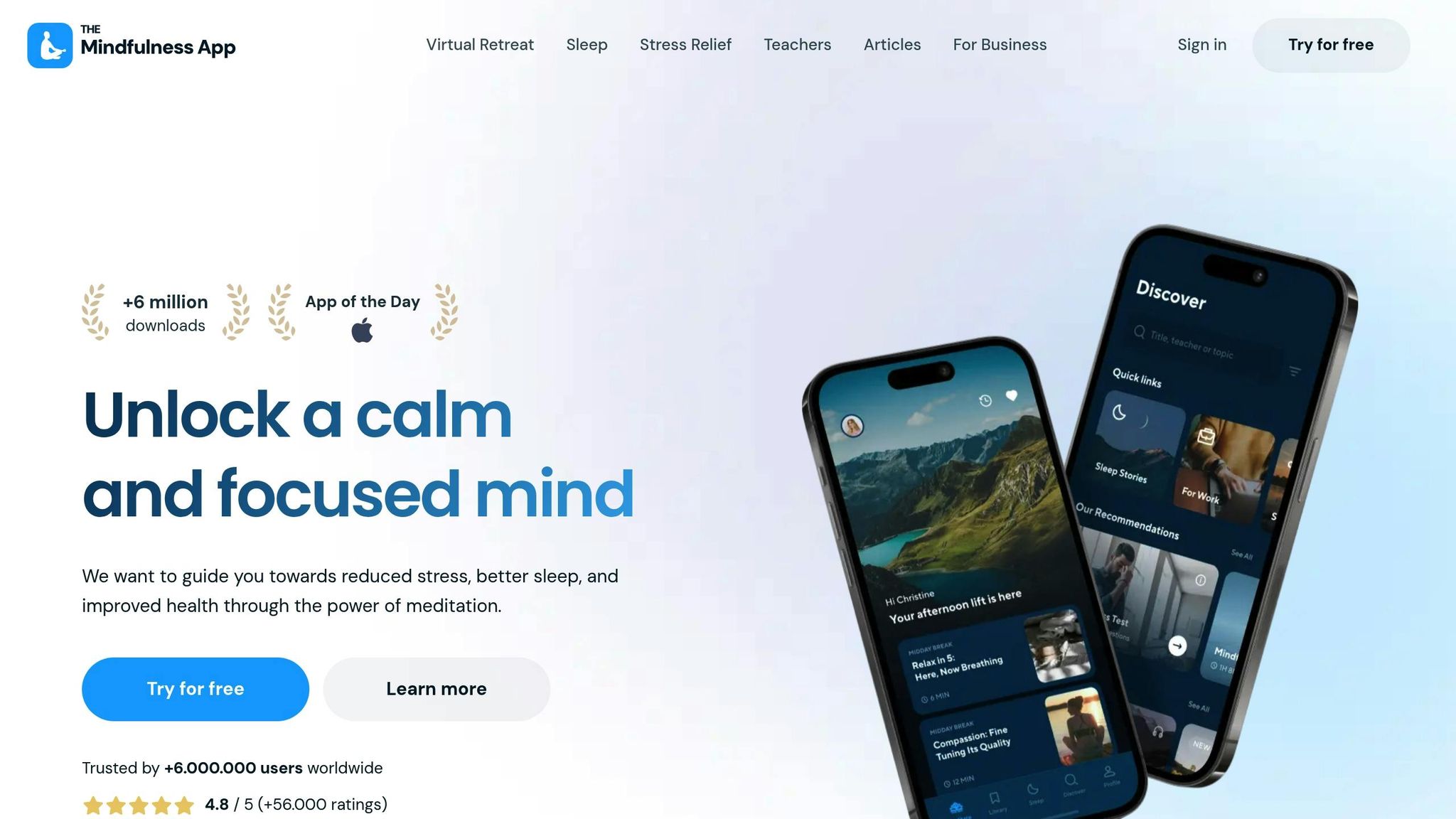
The Mindfulness App can be a powerful ally in maintaining focus and managing tasks. It offers guided meditations tailored to work sessions, helping you prepare for challenging tasks or transition smoothly between activities. With over 500 tracks available in 12 languages, you can easily find meditations that fit your workflow - whether you need to calm your mind before a meeting or reset after a demanding project.
During the 5-minute breaks between Pomodoro sessions, the app provides short breathing exercises and body scans to help you relax and recharge. Its offline functionality ensures you can stay consistent, even without internet access. Plus, the app’s personalized meditation programs adapt to your needs, making it easier to build a mindful routine over time. With a 14-day free trial, you can explore its premium library and discover which tools work best for boosting your focus and productivity throughout the day.
Building Mindful Workday Routines That Last
Morning Mindfulness Practices
When you wake up, your cortisol levels naturally spike, preparing you to tackle the day’s challenges. This makes the first few moments after waking up a pivotal time to set a positive tone. Instead of reaching for your phone right away, take two minutes to focus on your breath while still in bed. This small act can help counterbalance the cortisol rush and keep you from diving headfirst into the distractions of emails and social media.
As you move through your morning, turn everyday tasks into opportunities for mindfulness. Take brushing your teeth, for example: pay attention to the feel of the bristles, the taste of the toothpaste, and the sound of the running water. When you have your morning coffee, notice the warmth of the cup, the aroma wafting up, and the taste of that first sip. These simple practices help you stay grounded and focused, building on earlier intention-setting techniques. Afterward, carve out 5 to 10 minutes for seated meditation. Use your breath as an anchor, and when your mind inevitably drifts, gently guide it back without judgment.
An effective morning routine is more than just a checklist - it’s about setting intentions. Instead of merely jotting down tasks, ask yourself, "What is my intention for today?". Whether it’s to stay calm, be supportive, or focus on key goals, visualize yourself embodying that intention while completing your top three priorities. Research suggests that the benefits of mindfulness, such as improved attention, can last for years. This intentional start to your day sets the stage for a smoother transition into your work schedule.
Midday Resets and Energy Check-Ins
Even with the best morning routine, it’s easy to slip into autopilot as the day wears on. This state often leads to stress and reactive decision-making. To break the cycle, schedule hourly mindfulness breaks. Set a timer to pause for just one minute, giving yourself a chance to reset and refocus. This simple habit can help you avoid what’s known as "action addiction", where you stay busy with low-priority tasks instead of focusing on meaningful work.
Transitions between meetings offer another chance for mindfulness. For example, take a short, mindful walk to your next meeting space. If you’re leading a meeting, start with two minutes of silence to help everyone mentally arrive, and end a few minutes early to allow for a mindful transition. If stepping away from your desk isn’t possible, try a quick posture check: sit with your feet flat on the floor, straighten your back, and take a few moments to notice your breath. Use this time to scan your emotions and physical sensations without judgment. These small resets can help you maintain the clarity and focus needed to stay aligned with your goals throughout the day.
End-of-Day Reflections
Just as mindfulness shaped the start and middle of your day, it can also bring closure. Before leaving work - or even during the final stretch of your commute - pause for a moment of silence or focus on your breath. This practice helps you release the stress of the workday and creates a clear boundary between your professional and personal life.
End your day with a brief reflection by asking yourself three questions: "What did I learn today?", "What am I proud of?", and "What could I do differently tomorrow?". Take a moment to revisit the intention you set in the morning by asking, "Did I live my intention?". This isn’t about being self-critical but rather observing with honesty. Celebrate what you accomplished instead of dwelling on unfinished tasks. Use these insights to identify your top three priorities for the next morning. This way, you’ll wake up with clarity and avoid falling back into autopilot mode.
sbb-itb-bea8dce
Solving Common Problems
Finding Time for Mindful Pauses
Many people think mindfulness requires long, drawn-out sessions, but even 1- to 5-minute practices can sharpen focus and cut down on distractions. Instead of adding mindfulness to your to-do list, integrate it into the natural pauses in your day - like waiting for an elevator, commuting, or even right after you hit "send" on an email. For instance, during your coffee break, take a single minute to focus on the warmth of the mug, the aroma, and the taste.
Try setting a timer to pause every hour for just 60 seconds of deep breathing. This simple habit can help break what researchers call "action addiction", where you stay busy with low-priority tasks. These pauses calm your nervous system, shifting it from a reactive "fight-or-flight" mode to a more thoughtful state that supports better decision-making. In a study involving 4,000 participants, self-rated focus improved from 3.38 to 3.71 after practicing four brief mindfulness exercises. Another idea? End meetings five minutes early to create a mindful transition before your next task.
These short breaks don’t just help you feel calmer - they also reduce the mental strain caused by constant task switching, a major obstacle to productivity.
How to Stop Multitasking
Switching between tasks comes at a cost: it slows decision-making and increases mistakes. In fact, constantly changing focus can cut productivity by up to 40%. On top of that, the average knowledge worker juggles 10 different apps and switches between them as many as 25 times a day.
"We feel busy because we have a habit of doing one thing while thinking about the next." – Eric Langshur, Author and Entrepreneur
To combat this, start with timeboxing - set specific blocks of time for individual tasks and treat those blocks as sacred. During deep work sessions, activate "Do Not Disturb" on all your devices. Another effective method is the Pomodoro Technique, where you work in 25-minute focused intervals followed by a 5-minute break. This balances productivity with mental recovery. If distractions creep in, try the "Notice-Shift-Rewire" method: notice the distraction, redirect your focus, and spend 15–30 seconds re-engaging with your task. Participants in "Focus Sprints" who avoided multitasking reported feeling 43% more productive.
Focusing on one task at a time not only boosts efficiency but also reinforces mindfulness principles.
Handling Interruptions and Distractions
Interruptions are a fact of life, but how you handle them can make or break your productivity. Research shows it takes about 23 minutes to fully regain focus after being interrupted. That’s why managing distractions is essential. The key lies in cultivating both focus (staying present with your task) and awareness (recognizing and letting go of unhelpful distractions).
When your phone buzzes or you get a notification, pause and take a single mindful breath before reacting. This brief moment allows you to choose a response that aligns with your priorities rather than acting on impulse. For a quick mental reset after a big distraction, try the 4-7-8 breathing technique: inhale for 4 seconds, hold for 7, and exhale for 8.
Another tip? Schedule dedicated times to check email instead of leaving your inbox open all day. Avoid diving into emails first thing in the morning when your focus and creativity are at their highest. If an interruption frustrates you, don’t suppress the feeling - acknowledge it. Notice the physical sensations and emotions it stirs up. This "handshake with stress" approach helps you respond thoughtfully rather than reacting out of irritation. Repeatedly bringing your attention back to your breath strengthens your ability to concentrate.
Mindfulness at work: a superpower to boost productivity and wellbeing | Shanel Munger | TEDxPretoria
Conclusion: The Power of Mindful Task Management
Mindfulness isn’t about working slower - it’s about working smarter. By bringing awareness to your tasks, you move away from autopilot mode and into focused, intentional action. This shift transforms how you handle priorities, maintain concentration, and complete your work. Consider this: research reveals that people spend about 47% of their waking hours thinking about something other than what they’re doing. That’s a lot of mental energy lost to distractions - energy mindfulness can help you reclaim.
But the impact of mindfulness goes beyond just getting things done. Studies show that practicing mindfulness daily for eight weeks can lead to better attention, improved memory, enhanced mood, and stronger emotional regulation. Happier workers, on average, are 12% more productive, with some seeing productivity increases of up to 20%. These benefits ripple through your day, helping you manage interruptions, make clearer decisions, and finish work feeling less drained. Small changes like these can make a big difference in how you approach your day.
"Mindfulness is not about living life in slow motion. It's about enhancing focus and awareness both in work and in life." – Rasmus Hougaard and Jacqueline Carter, Potential Project
This guide introduces practical habits designed to combat distractions and the pitfalls of multitasking. Practices like single-tasking, mindful pauses, intentional transitions, and structured routines don’t require hours of meditation. Start small - try one or two minutes of focused breathing when you sit down to work. Take 60-second pauses every hour or use your commute as a mental reset between work and home. These simple habits build over time, making it easier to concentrate and helping focus feel almost effortless.
Mindful task management isn’t just another productivity tip - it’s a way to work that protects your mental well-being, sharpens your decision-making, and ensures you’re fully present for what matters most. Why not start today?
FAQs
How can mindfulness help me stay focused and productive at work?
Mindfulness can boost your productivity by sharpening your focus, easing stress, and encouraging a more intentional approach to tasks. Here are a few easy ways to weave mindfulness into your workday:
- Set an intention in the morning: Spend 30 seconds after waking up to pause, close your eyes, and mentally commit to staying focused and present throughout the day.
- Take mindful breathing breaks: Once every hour, stop for a minute and take slow, deep breaths. This simple habit can refresh your mind and combat mental fatigue.
- Be present with your tasks: If your mind starts to wander while working, gently guide your focus back to the task at hand. This helps minimize distractions and allows you to work more efficiently.
For a little extra support, try guided meditations to enhance your focus and clarity. The Mindfulness App offers quick, tailored sessions that can help you reset and stay centered, even on the busiest days. Making mindfulness a regular part of your routine can reshape how you work, leaving you more focused, effective, and calm.
What are some easy mindfulness techniques to improve focus and manage tasks?
Start incorporating a few mindfulness habits into your day to sharpen your focus and improve how you manage tasks. These quick techniques only take a minute or two and can seamlessly fit into even the busiest schedule:
- Set a daily intention: Begin your morning with a deep breath and a clear purpose in mind. For example, you might think, "I’ll focus on one task at a time" or "I’ll approach today with patience for myself and others."
- Take mindful breathing breaks: Feeling distracted? Pause for a moment. Breathe in for 4 seconds, hold it for 2 seconds, and exhale for 6 seconds. Repeat this cycle three times to refocus your mind.
- Recognize your emotions: Spend a moment identifying what you’re feeling. Whether it’s "I’m stressed" or "I’m calm," simply naming your emotions can help you feel more centered.
Even practicing just one or two of these techniques each day can help you stay composed, focused, and ready to tackle your to-do list with clarity.
Why is focusing on one task better than multitasking?
Focusing on one task at a time - known as single-tasking - helps your brain perform at its best. When you multitask, your brain is forced to engage in context-switching, which means constantly shifting focus between activities. This not only slows down your thought process but also increases errors and can lower productivity by as much as 40%. On top of that, multitasking leads to mental fatigue, making even straightforward tasks feel more challenging and time-consuming.
By contrast, single-tasking allows you to devote your full attention to a single activity, boosting both accuracy and efficiency. Incorporating mindfulness practices can make this approach even more effective. These practices train your mind to stay present and resist distractions. Apps like The Mindfulness App provide guided meditations and exercises to help sharpen your focus, making it easier to stay on task and work more efficiently.