

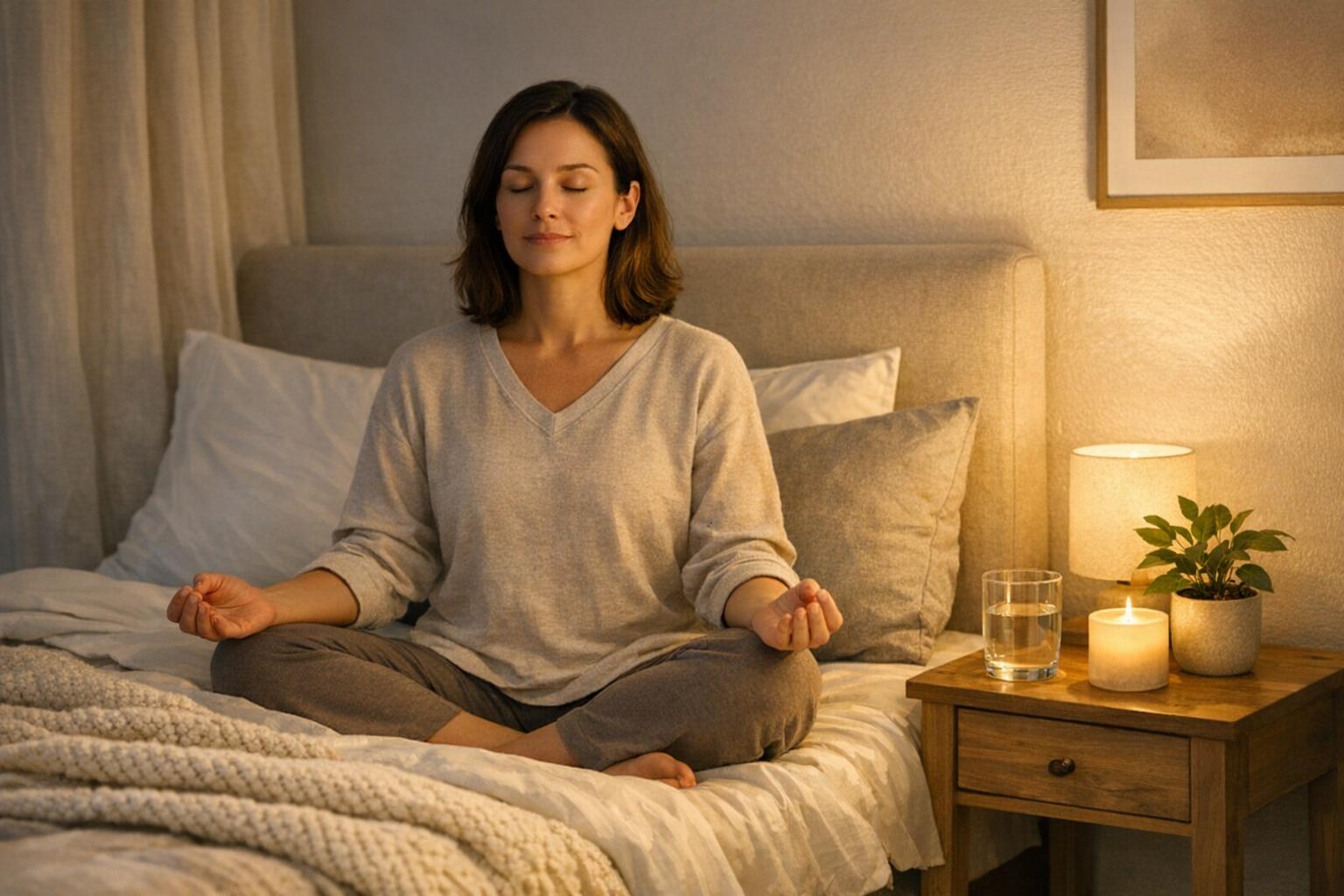
Struggling to sleep? Guided meditation might be the solution. It helps calm your nervous system, reduce racing thoughts, and improve overall sleep patterns. Unlike medications, it addresses the root causes of sleep issues without side effects. Here’s what you need to know:
- Why it works: Meditation activates the relaxation response, lowering stress and helping you transition to sleep.
- Key benefits: Studies show it reduces wake time by up to 43 minutes and improves sleep quality on par with exercise or therapy.
- Techniques to try: Body scans, 4-7-8 breathing, and visualization are simple ways to ease into better rest.
- Long-term effects: Regular practice reshapes sleep habits and reduces insomnia symptoms.
Start with just 10–30 minutes a day, pair it with a calming bedtime routine, and see the difference in your sleep. Guided meditation is a natural, effective way to wake up feeling refreshed and ready for the day.

Guided Meditation Sleep Benefits: Key Statistics and Results
Sleep Problems That Guided Meditation Can Solve
Trouble Falling Asleep
Struggling to fall asleep often comes down to one thing: racing thoughts. According to a survey of 12,151 meditation app users, a staggering 82% said racing thoughts were the main reason they had trouble drifting off. When your mind replays worries or the events of the day, it stays in an alert, goal-focused state, making it hard to relax into sleep.
Guided meditation can help quiet your mind and shift it out of that overactive state. By using techniques like deep breathing and guided imagery, meditation encourages your body to activate its relaxation response. This means lower heart rate, reduced muscle tension, and an overall sense of calm - all of which prepare you for sleep. It’s also effective at addressing other issues, like waking up repeatedly during the night.
Waking Up During the Night
Interrupted sleep is another common problem, with about 35% of Americans reporting difficulty staying asleep at least three nights a week. These nighttime awakenings are often tied to stress responses that keep your sleep light and easily disrupted by small disturbances.
Meditation can help by calming the emotional stress that comes with waking up in the middle of the night. This "secondary arousal" - the frustration or anxiety about not sleeping - can keep you stuck in a cycle of fragmented rest. Research shows that meditation can significantly reduce Total Wake Time, with over half of participants experiencing remission from these disruptions within six months. By soothing your nervous system, meditation promotes a steadier, deeper sleep.
Poor Sleep Quality and Daytime Tiredness
Even when you spend enough hours in bed, poor-quality sleep can leave you feeling drained the next day. If you’re not getting enough deep, restorative sleep, fatigue can follow you around like a shadow.
One study led by Dr. David S. Black at UCLA tracked 49 older adults with moderate sleep disturbances over six weeks. Those who practiced Mindful Awareness Practices saw their Pittsburgh Sleep Quality Index scores improve from 10.2 to 7.4, compared to 10.2 to 9.1 in the control group. They also reported less fatigue and fewer symptoms of depression. The effect size for sleep quality improvement - 0.89 - was on par with results from exercise or cognitive behavioral therapy, highlighting meditation’s potential to tackle both nighttime sleep challenges and daytime tiredness.
How Guided Meditation Improves Sleep
Calming Your Nervous System
Guided meditation triggers your body's parasympathetic system - often called the "rest-and-digest" system - which helps lower your heart rate, ease muscle tension, and reduce overall arousal. These changes create the perfect conditions for restful sleep.
The science backs this up. In a randomized controlled trial, participants practicing meditation-based techniques saw their pre-sleep arousal scores drop by an impressive 7.13 points, compared to just a 0.16-point reduction in the control group. Meditation also lowers inflammatory markers like NF-κB, showing that it calms your nervous system at a cellular level. This physical relaxation lays the foundation for managing mental stress, making it easier to drift off.
Reducing Stress and Racing Thoughts
One of the most frustrating barriers to sleep is a racing mind. Guided meditation helps you handle intrusive thoughts by changing how you respond to them. Instead of trying to push thoughts away, meditation encourages you to observe them without judgment. As Dr. Jason C. Ong from Northwestern University puts it:
"Rather than engaging in a sleep-related thought as something to analyze and solve, thoughts and feelings are treated as mental events to observe without judgment or action."
This approach, known as de-centering, breaks the cycle of overthinking and emotional arousal that often disrupts sleep. By creating mental space and calm, meditation helps you transition into a more peaceful state, setting the stage for restorative rest.
Improving Sleep Patterns Over Time
The benefits of guided meditation go beyond immediate relaxation - it can reshape your sleep habits over time. Regular practice reduces pre-sleep arousal and reframes how you think about sleep, leading to lasting improvements. A meta-analysis found that these changes can significantly enhance sleep quality, with effects lasting anywhere from 5 to 12 months and showing a moderate effect size of 0.54.
The long-term impact is striking. In one study, participants experienced a 50% remission rate in chronic insomnia after six months, along with a nearly 50-minute reduction in time spent awake during the night. Dr. Ong highlights this potential:
"Mindfulness meditation appears to be a viable treatment option for adults with chronic insomnia and could provide an alternative to traditional treatments for insomnia."
The key to these lasting improvements? Consistency. Dedicating just 10 to 30 minutes a day to meditation can gradually transform how your mind and body approach sleep. Unlike sleep medications, which often lose their effectiveness once you stop using them, meditation promotes lasting changes that support better sleep over the long haul.
Guided Sleep Meditation, Stop Racing Thoughts, Anxiety Relief Sleep Hypnosis
sbb-itb-bea8dce
Guided Meditation Techniques for Better Sleep
Meditation can be a powerful tool for improving sleep quality. Here are some specific techniques designed to address common sleep challenges, such as physical tension and an overactive mind.
Body Scans and Progressive Muscle Relaxation
A body scan helps you tune into different areas of your body, allowing you to identify and let go of hidden tension. Begin at your feet and slowly move upward, focusing on each body part and releasing tension with every exhale. Progressive Muscle Relaxation (PMR) takes this a step further by having you tighten and then relax each muscle group. This practice helps you distinguish between tension and true relaxation, which can be particularly helpful for easing tight shoulders, jaw clenching, or back discomfort. Once your body starts to unwind, incorporating focused breathing can enhance your relaxation even more.
Breath-Focused Meditations
Breath-focused techniques are excellent for triggering your body’s natural relaxation response. Diaphragmatic breathing, where your belly rises and falls with each breath, can slow your heart rate, lower blood pressure, and calm your mind. A popular method is the 4-7-8 technique: inhale through your nose for 4 seconds, hold your breath for 7 seconds, and exhale through your mouth for 8 seconds. This structured breathing pattern helps quiet anxiety and disrupts cycles of racing thoughts. Once your breathing is steady, visualization can further soothe your mind.
Visualization and Guided Imagery
When your thoughts are racing or you're replaying the day’s events, visualization offers a calming alternative. Picture a serene setting, like a quiet forest or a sunny beach, and immerse yourself in the details - feel the warmth of the sun, hear the rustling leaves, or notice the gentle rhythm of waves. Engaging your senses helps ground your mind and shift focus away from worries. Dr. Melissa Young from Cleveland Clinic explains, “Think about your thoughts like watching a train in the distance. We don't need to hop on that train. Just let your thoughts come and then let them go.” This approach allows you to observe your worries without becoming consumed by them, helping your mind relax for sleep.
| Technique | How It Works | Best For |
|---|---|---|
| Body Scan | Focuses attention on different body parts to release tension | Physical restlessness and tension |
| 4-7-8 Breathing | Slows breathing and activates relaxation responses | Reducing anxiety quickly |
| Visualization | Shifts focus to calming mental images | Quieting an overactive mind |
| Progressive Muscle Relaxation | Alternates muscle contraction and release to ease stress | Relieving built-up physical tension |
Adding Guided Meditation to Your Bedtime Routine
Incorporating guided meditation into your nightly routine doesn’t require a major overhaul - just a few small adjustments. The trick is to start small and build a habit that sticks. When meditation becomes as automatic as brushing your teeth, that’s when you’ll notice the biggest difference in your sleep quality.
Building a Consistent Practice
Consistency is more important than duration. Even 10–30 minutes of guided meditation before bed can help train your brain to associate it with sleep. For example, a pilot study in September 2025, led by Dr. Yan Ma at the Osher Center for Integrative Health, followed 13 patients with chronic insomnia who used app-guided meditation for four weeks. The results? An impressive 91% compliance rate and a reduction in insomnia severity, with participants’ Insomnia Severity Index scores dropping by 4.5 points.
To make this work for you, set a consistent time each night for meditation - ideally the same time every evening. This routine helps signal to your brain that it’s time to wind down. Pair this with optimizing your sleep environment, and you’ll create a powerful foundation for better rest.
Creating a Better Sleep Environment
Your bedroom setup plays a huge role in supporting your meditation and sleep. For starters, keep the room temperature between 65°F and 68°F - studies suggest this is ideal for restful sleep. Block out external light with blackout curtains or shades, and if noise is an issue, consider heavy curtains or a white noise machine to dampen sounds.
Another key step? Dedicate the hour before bed to screen-free activities. Put your devices away or enable "Do Not Disturb" mode to reduce blue light exposure, which can interfere with your natural sleep cycle. By creating a calm, distraction-free environment, you’ll make it easier to relax and focus on your guided meditation.
Using The Mindfulness App for Sleep Meditations

The Mindfulness App is a great tool for weaving meditation into your bedtime routine. It offers over 500 tracks in 12 languages, many of which are tailored to help with racing thoughts and pre-sleep anxiety. One standout feature is offline access, which lets you download meditations ahead of time - perfect for avoiding the temptation to scroll online when you should be unwinding.
The app also includes beginner-friendly programs like "7 Days of Sleep", where you’ll learn techniques like body scans and 4-7-8 breathing. To keep things seamless, you can set an "auto-stop" timer so the audio doesn’t play all night. And remember: reserve your bed for sleep only - this strengthens the connection between your bedroom and rest, making it easier to drift off.
Conclusion
Dealing with sleepless nights or battling insomnia? Guided meditation offers a practical way to address both the mental and physical challenges that keep you awake. By soothing your nervous system, quieting racing thoughts, and easing the anxiety tied to falling asleep, meditation tackles the root causes of sleep troubles instead of just covering up the symptoms.
"Mindfulness meditation appears to be a viable treatment option for adults with chronic insomnia and could provide an alternative to traditional treatments for insomnia." - Dr. Jason C. Ong
This insight highlights how regular meditation can gradually reshape your sleep patterns for the better.
Dedicating just 10–30 minutes to meditation before bed can help train your brain to rest more effectively. Over time, it can also reduce daytime fatigue, lift your mood, and improve your ability to manage stress. Studies show that sticking to a consistent meditation practice brings steady improvements in sleep quality.
Start small, create a bedtime routine, and give yourself the time to see the benefits unfold. With regular practice, you might find not only deeper, more restful sleep but also a greater sense of calm and balance in your daily life. By aligning your mind and body, this simple habit can set the stage for overall wellness.
FAQs
How does guided meditation help improve sleep compared to traditional sleep aids?
Guided meditation offers a natural and side-effect-free way to improve sleep quality, tackling challenges like insomnia, restlessness, and daytime fatigue. Studies suggest that mindfulness-based techniques can help you fall asleep faster, stay asleep longer, and wake up feeling more refreshed. Unlike conventional sleep aids, guided meditation doesn't come with drawbacks like grogginess, dependency, or tolerance.
Rather than chemically altering your sleep patterns, as prescription or over-the-counter medications do, guided meditation works by soothing the mind, easing stress, and encouraging relaxation. It’s a safer, more balanced approach to achieving better sleep and enhancing overall well-being.
What are the best meditation techniques for beginners to improve sleep quality?
If you’re just starting out with meditation and are looking to improve your sleep, a few straightforward techniques can make a noticeable difference.
Guided meditation is an excellent place to begin. Listening to a calming voice walk you through relaxation exercises or soothing stories can help quiet your mind and prepare your body for rest. Apps like The Mindfulness App offer beginner-friendly options designed to make this process simple and approachable.
Breathing exercises, like the 4-7-8 method, are another powerful tool. Here’s how it works: breathe in through your nose for 4 seconds, hold the breath for 7 seconds, and then exhale slowly for 8 seconds. This steady rhythm can ease stress and encourage relaxation.
Body-scan meditation is another effective technique. This involves mentally focusing on each part of your body, starting at your toes and moving upward, while intentionally releasing tension along the way. It’s a great way to reduce physical stress and settle into a state of calm.
To get the most out of these practices, try combining them into a nightly routine. For instance, you could begin with 5–10 minutes of guided meditation, follow it with a few cycles of deep breathing, and wrap up with a body scan. Practicing at the same time each evening can help signal to your mind and body that it’s time to wind down for better sleep.
How soon can guided meditation help improve my sleep?
Many individuals report better sleep quality after incorporating guided meditation into their daily routine for just 2 to 3 weeks. The secret lies in consistency - regular practice helps quiet the mind, ease stress, and encourage relaxation, all of which are crucial for achieving restful sleep.