


Starting your day with mindfulness can transform how you work and feel throughout the day. Instead of rushing into emails or notifications, a calm, intentional morning routine helps you focus, reduce stress, and plan effectively. Research shows that nearly 47% of our waking hours are lost to distractions, often starting right after waking up. By dedicating just 5–30 minutes to mindfulness practices like meditation, deep breathing, or gentle movement, you can improve clarity, emotional balance, and energy levels.
Key takeaways:
- Avoid checking your phone first thing in the morning to prevent mental clutter.
- Use short mindfulness practices (2–10 minutes) to calm your mind and set priorities.
- Gentle morning movement boosts circulation and sustained focus.
- Track progress by measuring task completion, stress levels, and energy throughout the day.
A mindful start doesn’t require a major overhaul - small, consistent steps can make your mornings more productive and less chaotic.
My Minimalist Morning Routine | Healthy and Mindful Habits for a Calm Morning
Productivity Problems from Disorganized Mornings
Starting your day by reaching for your phone might seem harmless, but it can set the tone for a day filled with scattered focus and low energy. That quick scroll through emails or social media can hijack your brain before it's even had a chance to wake up fully. The ripple effects show up in several ways that are closely tied together.
Mental Fog and Reduced Clarity
When your morning begins in chaos, your brain struggles to settle, leading to mental fog. Diving into emails and notifications right after waking forces your brain to make a series of small, unnecessary decisions before it’s ready, which can cause decision fatigue. This drains the mental energy you’ll need for more important tasks later in the day.
"You're essentially asking your prefrontal cortex to process dozens of micro-decisions while it's still warming up. Research shows this spikes stress hormones and depletes the mental reserves you need for actual important choices later."
– Sarah Thompson, Ahead App
The issue worsens if you’re dehydrated. Since the brain is roughly 75% water, going 6–8 hours without fluids during sleep can leave you mildly dehydrated. Even a 2% drop in hydration levels can impair your focus, memory, and mood. Add a sugary breakfast to the mix, and you’re likely setting yourself up for a mid-morning energy crash, making it even harder to stay sharp.
Higher Stress and Emotional Drain
Kicking off your day with disorganized habits, like scrolling through emails or news, can also take a toll on your emotional well-being. Seeing a flood of notifications or reading stressful headlines triggers a cortisol spike, putting your body into fight-or-flight mode. This heightened state can disrupt your focus for hours.
Your body naturally experiences a cortisol awakening response within the first 30 minutes of waking - a surge meant to energize you. But adding digital stress during this window amplifies the cortisol spike, often leading to a mid-morning crash. Studies show that starting your day in this reactive mode can make it 40% harder to manage emotions effectively throughout the day.
Weak Time Management and Task Prioritization
A chaotic morning can make it difficult to reconnect with your goals and set clear priorities. Instead, you might find yourself jumping between tasks without a plan, leaving you feeling reactive rather than proactive. Consuming news or social media first thing adds to this cognitive overload, filling your mind with distractions and emotions that sap your focus.
A 2025 study published in the Journal of Applied Psychology revealed that disruptions to morning routines lead to reduced calmness, increased mental exhaustion, and lower engagement throughout the day. By the time you attempt to tackle meaningful work, your willpower may already be depleted, leaving you drained well before lunch.
"Taking time to reattach to work helps our work goals to become more salient, which energizes us to focus."
– Jessica Lindsey, Contributor, Inc.com
How Mindful Mornings Boost Focus and Productivity
Mindfulness practices can turn the chaos of early mornings into a foundation for a productive day. By helping your brain stay present, calming your nervous system, and building mental focus, these practices set the tone for clarity and efficiency. Here’s how specific mindfulness techniques can reshape your mornings.
Clearing Your Mind with Morning Meditation
Starting your day with just 2 to 10 minutes of meditation can work wonders for mental clarity. By focusing on your breath or repeating a simple mantra, you train your mind to stay in the moment instead of jumping between scattered thoughts. This helps reduce the "mental noise" that can lead to disorganization and distraction.
Research involving 151 professionals revealed that those who used their mornings to mentally prepare for the day reported higher energy levels and greater engagement throughout their workday. Taking a few moments to reflect on your goals - why they matter and what requires your attention - can help anchor your focus and make your tasks feel more purposeful.
Lowering Stress with Mindfulness Techniques
Meditation lays the groundwork for calm, but additional mindfulness strategies can tackle the natural cortisol spike many experience upon waking. The 4-7-8 breathing technique (inhale for 4 seconds, hold for 7, exhale for 8) is particularly effective. It activates your parasympathetic nervous system, signaling safety and easing you out of the fight-or-flight state. This not only lowers stress but also enhances emotional balance.
Practicing gratitude - identifying three things you’re thankful for - shifts your brain’s focus from stressors to resources, promoting a more positive mood. Studies show that morning meditators are 20% more likely to maintain a positive outlook throughout the day. Another helpful tool is the 5-4-3-2-1 grounding method, where you identify five things you see, four you can touch, three you hear, two you smell, and one you can taste. This exercise interrupts anxious thought patterns and brings your attention back to the present.
Increasing Energy with Mindful Movement
Once you’ve cleared your mind and reduced stress, gentle movement can help sustain that focus and energy. Activities like stretching, yoga, or a short walk boost circulation, ease stiffness, and prepare your body for the day ahead. These movements promote a steady, calm energy while reducing physical tension, such as tightness in the stomach or irregular heart rhythms. They also help prevent those dreaded midday crashes by conserving your body’s energy reserves.
Interestingly, 60% of people who incorporate morning exercise report improved focus lasting 60 to 120 minutes afterward. The key here isn’t intensity but intention - treat movement as a self-care ritual rather than a performance. Something as simple as a five-minute walk outdoors, free from devices, can reset your internal clock and enhance alertness for hours.
"Think of the morning as a loading dock, not a battlefield; a two-minute inspection prevents damaged goods from being sent out."
– Pliability Team
sbb-itb-bea8dce
Building Your Mindful Morning Routine
Creating a mindful morning routine doesn’t have to be overwhelming. In just 5 to 30 minutes, you can turn chaotic mornings into calm, productive starts. The key isn’t a complete lifestyle change but incorporating small, repeatable actions that fit your everyday life. Below, you’ll find practical steps to help you bring mindfulness into your mornings.
Step-by-Step Morning Routine
Start your day by resisting the urge to check your phone. Instead, take a moment to set a positive intention, like “I’ll handle challenges with curiosity” or “I’ll focus on what’s within my control.”
Next, dedicate 5 to 10 minutes to clearing your mind. This could involve guided meditation or deep breathing exercises to help you feel centered. Follow that with some gentle movement - stretching, yoga, or even a short walk can energize your body and mind. Finally, take a few minutes to plan your day intentionally. Reflect on three simple prompts: why your work matters, who supports you, and which task deserves your focus today. Studies show this kind of reflection can boost both inspiration and engagement throughout your day.
Using The Mindfulness App for Your Routine

The Mindfulness App is a helpful tool for keeping your routine on track. With over 500 guided meditations, sleep stories, and courses, it offers sessions tailored to various time frames and needs. Whether you have just 3 minutes or a bit longer, there’s something to fit your schedule. Plus, the app’s premium features are available in 12 languages and can be accessed offline, making it convenient for any situation.
You can start with a 14-day free trial to explore the app’s offerings. Many users enjoy its flexibility, choosing meditations based on their morning needs - whether it’s reducing stress, gaining clarity, or boosting energy. Over time, these sessions can help make mindfulness a natural part of your daily routine.
Maintaining Your Routine Long-Term
Consistency is more important than perfection. Begin with short practices (just 1 to 5 minutes) and adjust as needed. If you miss your routine a few times, simplify it rather than giving up entirely. For instance, use the “if-then” rule: if your energy feels low (below 4 out of 10), opt for a quick two-minute practice, like taking three deep breaths, instead of skipping your routine altogether.
Reinforce your habits by linking them to existing ones. For example, practice mindful breathing while brushing your teeth or reflect on gratitude while waiting for your coffee. Preparing the night before can also help - lay out your clothes, tidy your space, or jot down one priority task to reduce decision fatigue in the morning. Visual cues, like sticky notes on your mirror or a journal on your nightstand, can serve as gentle reminders. Research shows that small, consistent practices often become second nature by the third week.
"Complex routines lead to avoidance, while small, repeatable rituals build adherence."
– Pliability Team
Measuring Your Productivity Improvements
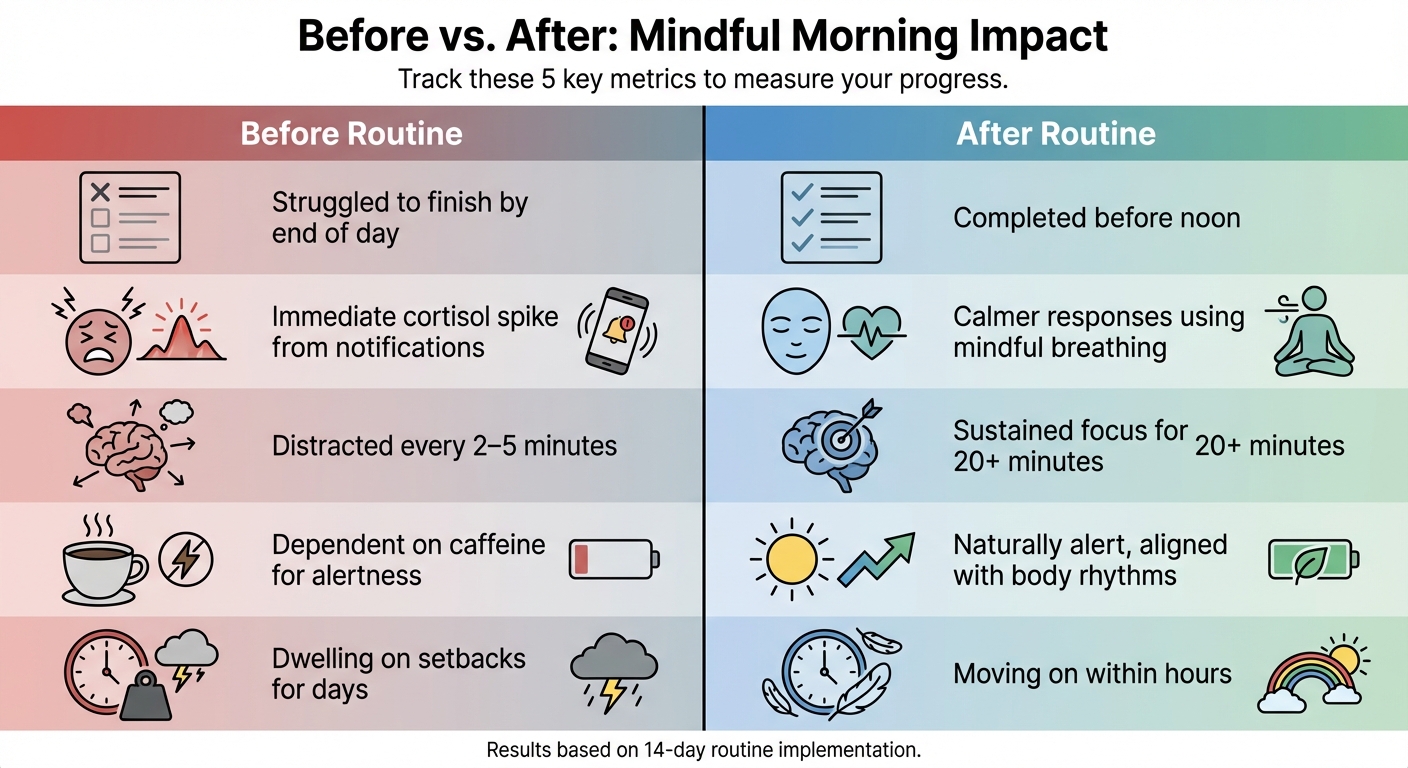
Before and After Mindful Morning Routine: Productivity Metrics Comparison
What to Track and Measure
To gauge the success of your mindful morning routine, focus on tracking specific metrics. Start with your task completion rate - note how many of your top three priorities are finished before noon. This can reveal when you're most productive during the day.
Another key area to monitor is your stress response. Use a simple 1–10 scale to rate your stress levels during a quick morning check-in. Reassess after facing challenging moments to see how quickly you recover. Faster recovery times can signal growing emotional resilience .
Lastly, pay attention to your focus duration and energy levels. Are you staying alert naturally, or relying on caffeine? Tracking these patterns can help you identify meaningful changes over time .
Creating a Before-and-After Comparison
Once you've identified what to measure, establish a baseline. Spend a week noting your morning energy levels, how many top priorities you complete, and what triggers your stress. After that, commit to a 14-day trial of your new routine to give yourself enough time to notice measurable improvements.
Here’s a helpful way to compare your progress:
| Metric | Before Routine | After Routine |
|---|---|---|
| Top-3 Tasks Completed | Struggled to finish by end of day | Completed before noon |
| Stress Response | Immediate cortisol spike from notifications | Calmer responses using mindful breathing |
| Focus Duration | Distracted every 2–5 minutes | Sustained focus for 20+ minutes |
| Energy Source | Dependent on caffeine for alertness | Naturally alert, aligned with body rhythms |
| Emotional Recovery | Dwelling on setbacks for days | Moving on within hours |
Track any noticeable changes, such as feeling more grounded during stressful moments or experiencing less physical tension. These small but concrete improvements highlight the positive impact of sticking to your routine.
Conclusion
Turning a chaotic morning into a mindful routine can transform how your entire day unfolds. Mindful mornings aren’t about cramming in more tasks - they’re about starting the day with intention rather than reacting to whatever comes your way. Taking a moment to ground yourself before diving into the day sends a clear message to your nervous system: you’re safe. This shift from a reactive state to a calm one opens the door for clearer thinking and better decision-making. Even a simple 2–5 minute mindfulness practice can help rewire your brain to handle emotions more effectively.
"Mindful mornings don't require perfection. They require presence." - Adelson Behavioral & Mental Health
Studies suggest that nearly half of our waking hours are spent distracted from the task at hand. By starting your day with mindfulness, you reclaim that focus and carry it with you, leading to faster stress recovery, sharper concentration, and a more proactive mindset throughout the day.
You don’t need to overhaul your routine to see results. Small, intentional changes can make a noticeable difference. For example, take a few deep breaths while brushing your teeth, set an intention as your coffee brews, or resist the urge to check your phone first thing in the morning . These small moments of mindfulness can lay the groundwork for meaningful, lasting change.
Track what matters most to you - whether it’s knocking out your top priorities before noon, feeling more composed during stressful moments, or cutting back on caffeine to sustain your energy. Measuring these improvements will help reinforce the habit and keep you motivated. When you take control of your mornings, you take control of your day.
FAQs
What’s the fastest mindful morning routine that still works?
A mindful morning routine doesn’t have to take up much of your time - just five minutes can make a difference. Simple practices like mindful breathing, a quick body scan, or a short meditation session can help clear your mind and reduce stress almost instantly. These exercises are easy to squeeze into even the busiest mornings, helping you start your day feeling calm and focused.
How can I stop checking my phone right after waking up?
Starting your day without immediately reaching for your phone can set a more intentional tone for the hours ahead. Consider swapping out your phone alarm for an analog clock and placing it across the room. This small change keeps your phone out of arm's reach. Instead of diving into notifications, try beginning your morning with calming activities like meditation, light stretching, or jotting down thoughts in a journal. Following the "first hour rule" - avoiding screens for the first hour after waking - can help you ease into the day with a clear and focused mind.
How soon will I notice productivity gains from mindful mornings?
Starting mindful mornings can bring noticeable benefits surprisingly fast - sometimes within just minutes or hours. You might feel less stressed and more focused almost immediately. But the real magic happens over time. With consistent practice, the effects deepen, often becoming more pronounced over weeks or months. A regular mindfulness routine not only sharpens mental clarity but also boosts resilience, helping you maintain productivity all day long.