
Breathwork is a simple, science-backed way to calm your mind and manage emotions. By controlling your breathing, you can reduce stress, ease anxiety, and improve focus in just a few minutes a day. This practice works by activating your parasympathetic nervous system, lowering cortisol, and balancing oxygen and carbon dioxide levels in your body.
Key takeaways:
- 5 minutes daily: Controlled breathing, like cyclic sighing, improves mood more effectively than mindfulness meditation (Stanford study, 2023).
- Quick calming techniques: Practices like 4-7-8 breathing and box breathing shift your body from stress to relaxation.
- Proven benefits: Lower anxiety, stabilize emotions, and sharpen focus by engaging your vagus nerve and regulating heart rate variability.
Breathwork is free, easy, and accessible anywhere - whether you're in traffic, preparing for a big meeting, or winding down before bed. Start small with just a few minutes a day to feel more in control of your emotions.
This 5-Minute Breathing Exercise Improves Emotional Control (New Study) | Breath Lab
How Breathwork Affects the Brain and Body
Every deliberate breath you take influences your autonomic nervous system, which is responsible for managing your heart rate and stress levels.
This system has two branches: the sympathetic system, which triggers the "fight-or-flight" response, and the parasympathetic system, which promotes "rest-and-digest" functions. When stress hits, the sympathetic system takes over, causing your heart rate and blood pressure to spike. By consciously adjusting your breathing, you can quickly transition from a state of stress to one of calm. Let’s dive into how neural pathways and gas balance contribute to this emotional shift.
The Science Behind Emotional Regulation and Breathwork
One of the key players in breathwork's calming effects is the vagus nerve, a long cranial nerve that connects your brain to essential organs.
"It turns out that many of the activities that we associate with calmness - things like deep breathing, meditation, massage and even the experience of awe - effect changes in the brain, in part, through increasing vagus nerve activity."
– Vernon B. Williams, MD, Sports Neurologist, Cedars-Sinai
When you engage in slow, steady breathing (around 5–6 breaths per minute), the vagus nerve becomes more active. This activation lowers your heart rate, reduces blood pressure, and decreases cortisol levels. Interestingly, about 80% of the vagus nerve’s fibers are sensory, meaning they constantly relay information from your body back to your brain.
In 2017, Stanford University researchers discovered a group of neurons in the brainstem that link the breathing control center to the brain's arousal system. This finding explains why slow breathing can create a sense of calm. The effects are rapid too - a simple "physiological sigh" (a double inhale followed by a long exhale) can help shift your body out of a fight-or-flight state in just a few seconds.
Different breathing speeds can activate various parts of your nervous system. While slower breathing encourages relaxation through parasympathetic stimulation, faster-paced breathwork can intentionally induce short-term stress, which may help build resilience over time.
Beyond neural activity, breathwork also helps regulate blood gas levels, which plays a crucial role in emotional stability.
Balancing Oxygen and Carbon Dioxide Levels
Carbon dioxide (CO₂) isn’t just a waste product - it’s vital for maintaining emotional balance. When you slow your breathing, CO₂ levels in your lungs and blood increase slightly. This rise in CO₂ acts as a natural vasodilator, which means it widens blood vessels, allowing more oxygen-rich blood to flow to your brain and heart. This improved circulation enhances focus, emotional clarity, and cognitive performance.
"Carbon dioxide is not just a waste gas but acts as a natural vasodilator by opening up blood vessels and allowing more oxygen-rich blood to reach the brain and the heart."
– Patrick McKeown, Advisor, International Academy of Breathing and Health
Your body carefully maintains an acid-base balance (pH) through breathing, which is essential for the proper functioning of cells involved in emotional regulation. Disruptions to this balance - like those caused by rapid, shallow breathing - can lead to emotional instability. Insufficient oxygen levels (hypoxia) can worsen nervous system imbalances and amplify feelings of distress.
The balance of oxygen and carbon dioxide also affects key areas of the brain, such as the amygdala and hippocampus, which are central to emotional processing, memory, and focus. Controlled breathing helps maintain proper gas exchange, creating an environment where these brain regions can perform at their best.
Chemoreceptors located in your arteries and brain monitor changes in CO₂ and pH levels, adjusting your breathing automatically to maintain balance. By practicing controlled breathing, you not only calm your nervous system but also fine-tune the chemical environment that supports emotional stability.
Benefits of Breathwork for Managing Emotions
Now that we've covered how breathwork affects your brain and body, let’s dive into the real-world benefits you can experience with regular practice. These aren’t just theoretical ideas - they’re measurable changes that can help you handle emotional challenges more effectively.
Lowering Anxiety and Stress
When anxiety hits, your body floods with cortisol and other stress hormones, keeping you in a heightened state of alert. Controlled breathing helps activate your relaxation response, cutting down cortisol levels and easing stress. The result? Quick and noticeable relief.
In a January 2023 Stanford study with 111 participants, just 5 minutes of daily cyclic sighing improved positive affect by 1.91 points on the PANAS scale. Comparatively, mindfulness meditation showed a smaller increase of 1.22 points, with breathwork benefits lasting throughout the day.
"Controlled breathwork seems to be a straightforward way to do the opposite [of a panic attack]: lower physiologic arousal and regulate your mood."
– David Spiegel, Associate Chair of Psychiatry and Behavioral Sciences, Stanford Medicine
Research also shows that breathwork reduces subjective stress levels, with small-to-medium measurable effects. It has been proven effective in alleviating symptoms of anxiety and depression. Given that anxiety disorders have risen by 25.6% globally since the COVID-19 pandemic began, these findings are especially impactful.
Beyond immediate relief, regular breathwork builds long-term emotional resilience.
Stabilizing Mood and Emotions
Over time, breathwork strengthens your ability to handle emotional ups and downs. A key factor here is Heart Rate Variability (HRV) - the variation in time between heartbeats. Higher HRV is linked to better stress management and emotional regulation. Breathwork boosts HRV by encouraging a shift toward parasympathetic dominance, which helps your body stay calm under pressure.
Techniques like alternate nostril breathing and cyclic sighing help balance your mood and reduce irritability. By stabilizing the interaction between your sympathetic and parasympathetic nervous systems, breathwork helps you maintain a steady emotional baseline. This makes it easier to face stressful situations without feeling overwhelmed.
Improving Focus and Mindfulness
Breathwork doesn’t just calm you down - it sharpens your mental focus too. Unlike passive mindfulness meditation, which involves observing your breath, breathwork gives you active control over your autonomic nervous system. This allows you to quickly shift out of a stress response, clearing mental fog and boosting concentration.
By increasing brain oxygenation, breathwork enhances mental clarity. Techniques like coherent breathing, where you take six-second inhales and exhales, promote better communication between the brain’s hemispheres. This leads to more integrated and efficient cognitive processing.
While mindfulness meditation often requires 20 to 30 minutes to feel its effects, breathwork can deliver noticeable physiological and emotional benefits in as little as 5 minutes a day.
sbb-itb-bea8dce
Breathwork Techniques for Emotional Control
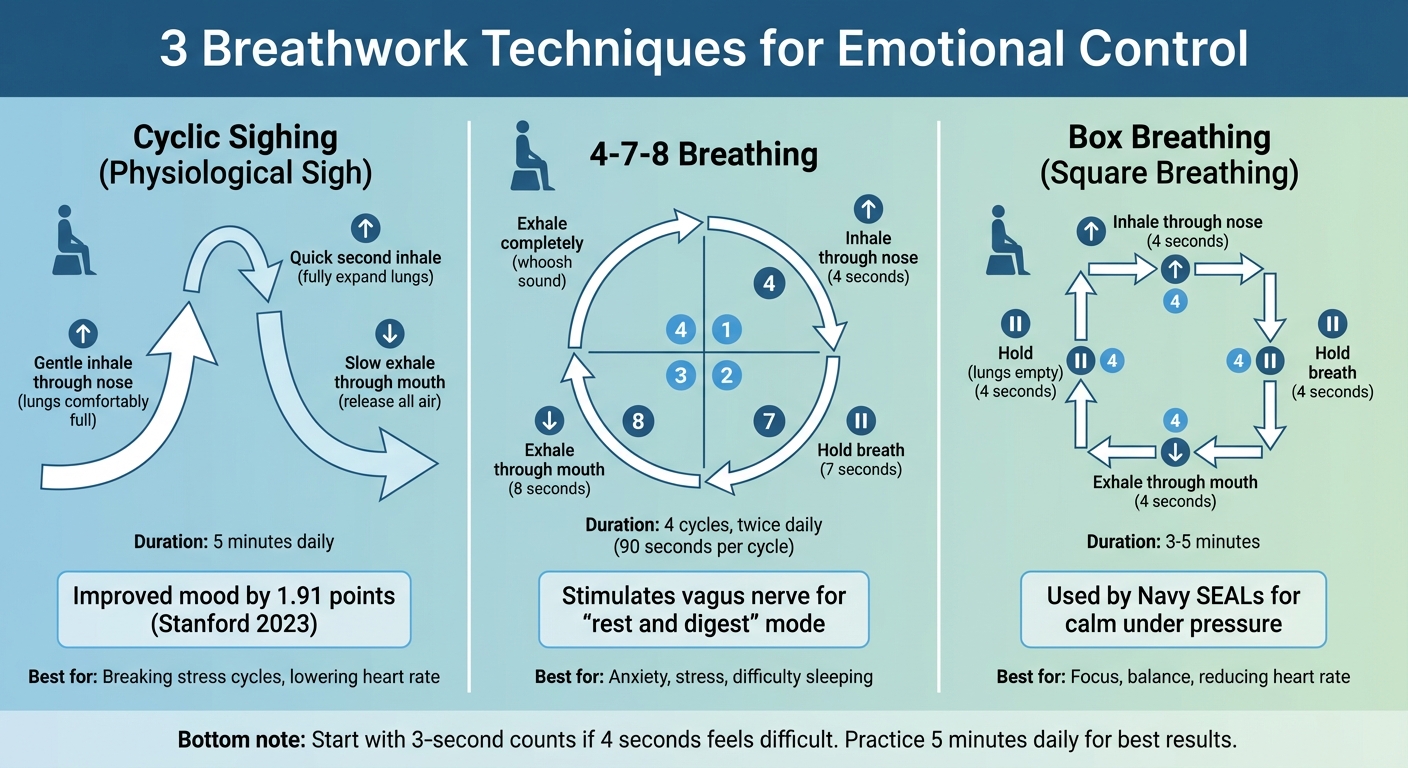
Three Evidence-Based Breathwork Techniques for Emotional Control
Building on earlier insights into the science and advantages of breathwork, these techniques are practical tools to help you manage your emotional state. Each method works differently, so you can choose the one that feels most effective for you.
Cyclic Sighing Technique
Often called the "physiological sigh", this technique focuses on extended exhalations to engage your parasympathetic nervous system, which helps slow your heart rate and ease anxiety. It’s especially useful for breaking the cycle of stress that keeps your heart racing and your mind spinning.
In January 2023, Stanford Medicine researchers, including Dr. David Spiegel and Dr. Andrew Huberman, published a study in Cell Reports Medicine. They found that participants practicing cyclic sighing for five minutes daily over a month experienced greater emotional improvements and a reduced resting respiratory rate compared to other breathwork groups.
To try cyclic sighing:
- Inhale gently through your nose until your lungs feel comfortably full.
- Take a quick, deeper second inhale to fully expand your lungs.
- Slowly exhale through your mouth until all the air is released.
Practicing this for five minutes daily can help you feel calmer and more in control.
4-7-8 Breathing Technique
The 4-7-8 breathing method is a rhythmic pattern designed to naturally calm your nervous system. Rooted in ancient yogic practices, it was popularized by Dr. Andrew Weil in 2015. This technique stimulates the vagus nerve, encouraging your body to shift into a "rest and digest" mode.
Here’s how to do it:
- Place the tip of your tongue against the ridge behind your upper front teeth.
- Exhale completely through your mouth, making a soft "whoosh" sound.
- Close your mouth and inhale quietly through your nose for 4 seconds.
- Hold your breath for 7 seconds.
- Exhale through your mouth for 8 seconds, making the "whoosh" sound again.
Each cycle takes about 90 seconds to complete.
"The 4-7-8 breath can be used for situations where you're feeling particularly anxious, stressed, or even if you have some difficulty falling asleep." – Dr. Ni-Cheng Liang, Pulmonologist and Mindfulness Teacher
Start with four cycles twice a day. As you get more comfortable, you can gradually increase the number of cycles. If you feel lightheaded, scale back the number of cycles or adjust your pace while keeping the 4-7-8 ratio intact.
Box Breathing Technique
Box breathing, also known as square breathing, is a method that brings balance and focus. Unlike cyclic sighing, which emphasizes longer exhalations, this technique uses equal timing for all phases of the breath. It’s a go-to practice for U.S. Navy SEALs, police officers, and athletes to maintain calm under pressure.
To practice box breathing:
- Inhale slowly through your nose for 4 seconds.
- Hold your breath for 4 seconds.
- Exhale slowly through your mouth for 4 seconds.
- Hold your breath, lungs empty, for another 4 seconds.
This steady rhythm can help shift your body from a "fight-or-flight" state to a more relaxed "rest-and-digest" mode, reducing heart rate and blood pressure.
You can incorporate box breathing into your routine by practicing for 3–5 minutes in the morning, during work breaks, or before bed. If 4-second counts feel difficult, start with 3 seconds and gradually work your way up. To enhance the practice, visualize a square or trace one with your finger as you breathe. Pairing this with a mindful body scan - releasing tension in areas like your forehead, jaw, or shoulders during exhalation - can amplify its soothing effects.
Creating a Daily Breathwork Routine
Integrating breathwork into your daily life doesn’t require a complete overhaul of your routine. The secret is to start small and find ways to incorporate these techniques into moments that naturally occur throughout your day.
Starting with Short Daily Sessions
Kick things off with just 5 minutes of focused breathing each day. Diana Winston, Director of Mindfulness Education at UCLA's Mindful Awareness Research Center, emphasizes:
"most of us have had 20, 30, 40, 50, or more years practicing being distracted; being able to focus on your breath for an extended period of time is not going to happen overnight".
Even a brief 5-minute practice can lead to noticeable benefits, such as improved mood and a lower resting breathing rate . If your mind wanders, try using an anchor like the sound of your surroundings or the sensation of sitting in your chair. Only extend your practice when it feels natural - there’s no rush.
Adding Breathwork to Everyday Activities
Breathwork fits seamlessly into your day because, after all, you’re already breathing thousands of times daily. You can practice box breathing while stuck in traffic or waiting in line - no one will even notice. Before a big meeting or presentation, try the physiological sigh for a quick reset. For physical tasks like climbing stairs or lifting something heavy, pursed-lip breathing can help make the effort feel lighter . Dr. Melissa Young, a Functional and Integrative Medicine Specialist at Cleveland Clinic, explains:
"When you do breathwork on a regular basis, you retrain your nervous system so that it can go into that relaxation response much more easily in the future".
To build confidence, practice these techniques in a quiet space before using them in more stressful or public situations .
Tracking Progress and Staying Consistent
Once breathwork becomes part of your day, tracking your progress can help you stay consistent and motivated. Monitoring just a few key metrics can make a big difference: your mood (on a 1–10 scale), physical energy levels, one key input (like morning sunlight or caffeine), and one key output (such as a productive work session).
Habit-stacking is another helpful strategy. For example, you might decide, "After my first sip of coffee, I’ll do 5 minutes of box breathing." Tools like the Mindfulness App can also make it easier to track your progress and notice how regular practice affects your emotional and physical well-being over time.
Consistency is what matters most. A short daily session of 3 to 5 minutes is more effective than an occasional 30-minute practice. By weaving these techniques into your routine, you’ll create a solid base for emotional balance and resilience as you continue exploring breathwork.
Conclusion
Did you know you take about 20,000 breaths every single day? That’s 20,000 opportunities to tap into a natural tool for managing emotions and calming your mind. Whether it’s pre-presentation jitters, frustration in traffic, or the need for a little extra calm, breathwork gives you a way to directly influence your nervous system. As Guy Fincham, Founder of the Breathwork Lab at Brighton & Sussex Medical School, explains:
"Breathwork is one of the simplest and profoundly effective tools we have for calming the nervous system and boosting physical and mental resilience."
Science backs this up. A January 2023 study from Stanford University observed 108 participants and found that just 5 minutes of daily cyclic sighing not only improved positive emotions but also lowered respiratory rates more effectively than mindfulness meditation. Techniques like focusing on longer exhales stimulate the vagus nerve, helping your body shift from stress to calm.
The best part? You don’t need fancy equipment or a huge time commitment. Just 2 to 5 minutes a day - while waiting for your coffee or at a stoplight - can make a difference. Simply focus on extending your exhale longer than your inhale. For extra support, apps like The Mindfulness App can help you stay consistent and explore different techniques.
Take one mindful breath today. It’s a small step toward building emotional balance and resilience, and over time, it can lead to meaningful changes in your overall well-being.
FAQs
How do I choose the best breathwork technique for my emotions?
Choosing the right breathing technique often comes down to what you need emotionally. Feeling overwhelmed? Try diaphragmatic breathing or the 4-7-8 method - both are great for triggering a sense of calm. If you're looking for quick relief, cyclic sighing might do the trick. For improving emotional balance over time, mindful breathing can be a solid choice. It’s worth experimenting with these methods to see which fits you best. Tools like The Mindfulness App can guide you through these practices and make it easier to incorporate them into your routine.
Why can slow breathing make me feel lightheaded or dizzy?
Slow breathing can sometimes make you feel lightheaded or dizzy. This happens because it can lower the amount of carbon dioxide in your blood, which in turn reduces blood flow to your brain. These sensations are generally short-lived and tend to fade as your body gets used to the breathing pattern.
How soon will I notice results from doing breathwork every day?
Daily breathwork can lead to noticeable changes in mood and help ease anxiety. These effects might be felt in as little as a few minutes or could take a few weeks to fully emerge. Research indicates that even just five minutes of practice each day can make a difference. The secret? Staying consistent with your practice is what brings lasting benefits.