


Mindful eating is about paying attention to your food and emotions. It helps you understand when you're truly hungry versus eating due to stress or boredom. This practice connects your eating habits with emotional awareness, leading to healthier choices and better self-control.
Key points:
- Mindful eating focuses on hunger signals, food textures, and emotions.
- Emotional eating often stems from stress, not physical hunger.
- Techniques like "decentering" help you observe cravings without acting on them.
- Research shows mindful eating reduces emotional eating and cravings.
- Tools like the Mindful Eating Inventory (MEI) measure progress in awareness.
Practical tips:
- Pause before eating and assess your hunger.
- Eat slowly, savoring flavors and textures.
- Use techniques like RAIN (Recognize, Allow, Investigate, Non-identify) to manage cravings with meditation.
- Consider apps or meditation to support mindfulness.
Mindful eating isn't about strict rules - it's about understanding your body and emotions to make intentional food choices.
See Why Mindful Eating Is Key to Improving Your Mental Wellbeing
sbb-itb-bea8dce
The Science Behind Mindful Eating
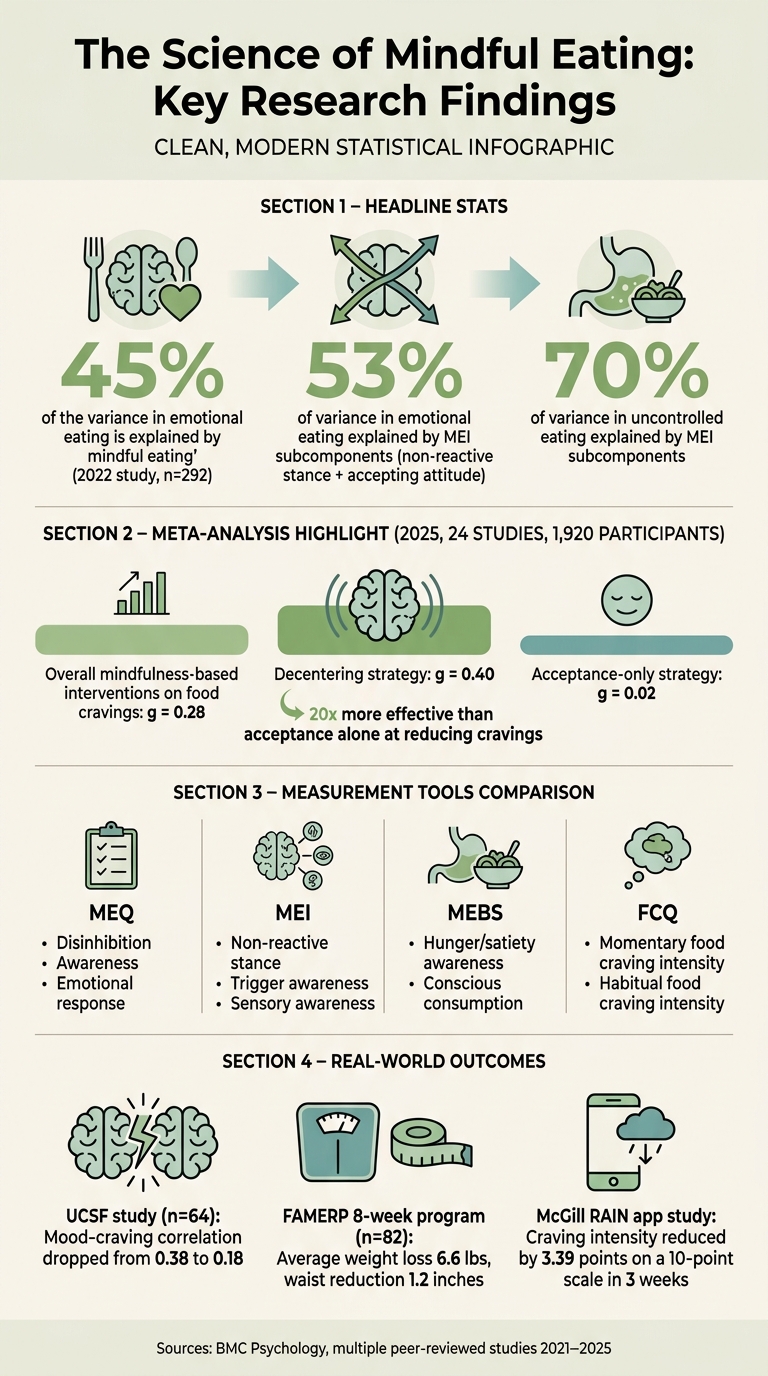
Mindful Eating & Emotional Awareness: Key Research Stats
How Mindfulness Builds Emotional Awareness
Mindful eating enhances your ability to tune into your body’s signals, helping you distinguish genuine hunger from emotional triggers. By focusing on how we experience cravings, mindfulness reshapes our responses to them.
One standout concept here is decentering - the practice of observing thoughts and cravings without acting on them immediately. This approach allows you to see cravings as fleeting events rather than something tied to your identity. Emotional eating often happens on autopilot, and mindfulness disrupts this cycle by altering how the brain reacts to emotional cues, giving you the space to pause before reaching for food.
These processes are at the heart of the research findings discussed below.
Key Research Findings
The data is compelling. A 2022 study involving 292 participants found that mindful eating accounted for 45% of the variance in emotional eating. Interestingly, when mindful eating was included in the analysis, general mindfulness practices no longer predicted emotional eating behaviors. This highlights that mindfulness tailored to eating habits is far more effective than broader mindfulness techniques in addressing food-related challenges.
A 2025 meta-analysis of 24 studies with 1,920 participants confirmed that mindfulness-based interventions significantly reduce the intensity of food cravings (effect size: g = 0.28). Notably, strategies focusing on decentering were more effective than those emphasizing acceptance alone (g = 0.40 vs. g = 0.02). In simple terms, learning to observe a craving without judgment works better than merely trying to accept its presence.
"Mindfulness has demonstrated efficacy in reducing stress, emotional eating, and stress-related overconsumption." - BMC Psychology
Tools Used to Measure Mindful Eating and Emotional Awareness
Researchers rely on several validated tools to measure the impact of mindful eating, each capturing different aspects of this behavior:
| Tool | What It Measures | Primary Use |
|---|---|---|
| Mindful Eating Questionnaire (MEQ) | Disinhibition, awareness, emotional response, distraction | Evaluates mindful eating traits and their connection to binge eating |
| Mindful Eating Inventory (MEI) | Non-reactive stance, awareness of triggers, accepting attitude, sensory awareness | Identifies key mechanisms that reduce unhealthy eating habits |
| Mindful Eating Behavior Scale (MEBS) | Hunger/satiety awareness, conscious consumption, eating without distraction | Tracks daily mindful eating patterns and related health outcomes |
| Food Craving Questionnaire (FCQ) | State (momentary) and trait (habitual) food cravings | Measures craving intensity before and after mindfulness practices |
Among these tools, the Mindful Eating Inventory (MEI) stands out. Studies using the MEI revealed that its subcomponents - especially the non-reactive stance and accepting attitude - explained 53% of the variance in emotional eating and nearly 70% of the variance in uncontrolled eating. These findings emphasize the importance of cultivating specific, trainable skills to transform one’s relationship with food.
How Mindful Eating Supports Emotional Awareness in Daily Life
Reducing Emotional Eating
Mindful eating helps you recognize and address emotional eating by encouraging what researchers call Awareness of Eating Triggers and Motives (ATM). This practice invites you to pause and ask yourself, "Am I actually hungry, or is this an emotional reaction?"
"The awareness of eating triggers is the first step in changing habitual maladaptive eating patterns." - D. Peitz, Researcher
A 2021 study conducted at UCSF involving 64 women with overweight showed a decrease in the link between negative moods and food cravings - from a correlation of 0.38 to 0.18. Even after a month, these results held steady. This kind of awareness not only interrupts emotional eating but also helps improve emotional regulation during stressful moments.
Better Stress Management and Emotional Regulation
Mindful eating goes beyond curbing cravings; it also helps you manage stress more effectively. In a six-week mindfulness program, participants showed marked improvement in their ability to handle food-related cues and control impulses, with effect sizes ranging from 0.58 to 1.54. The key lies in developing a non-reactive mindset - learning to notice urges without immediately acting on them. Even a quick breathing exercises before eating can help you build this skill over time.
Building Self-Compassion Around Food
One powerful aspect of mindful eating is how it encourages self-compassion. By fostering a nonjudgmental and accepting attitude toward eating habits, mindful eating can interrupt cycles of self-criticism and shame that often lead to overeating.
"By accepting the emotional or uncontrolled eating behavior, [an accepting and non-attached attitude] may buffer the effects of high self-criticism endangering dysfunctional circles that lead to more overeating." - D. Peitz, Researcher
This self-compassion becomes a cornerstone of mindful eating, making it easier to make healthier choices and reducing the emotional dependence on food.
Research-Backed Mindful Eating Practices
Core Mindful Eating Techniques
Mindful eating begins with tuning into your senses. Pay attention to the flavors, textures, and smells of your food. Slowing down - like eating with your non-dominant hand - can give your body more time to recognize when it's full. Another helpful tip? Pause before swallowing and try to identify three distinct flavors or textures in each bite.
In 2023, a study conducted by FAMERP followed 82 participants in an 8-week mindful eating program. The results were striking: participants lost an average of 6.6 pounds and reduced their waist circumference by 1.2 inches. These changes highlight how mindful eating not only supports weight management but also enhances emotional awareness. Lead researcher Tatiana Palotta Minari explained:
"ME can be a great alternative to severely restrictive diets which tirelessly seek to meet the social norms of an unattainable body standard."
Incorporating meditation practices alongside these sensory-focused techniques can take your mindful eating to the next level.
Combining Mindful Eating with Meditation
Pairing mindful eating with meditation can help address emotional eating triggers. For instance, "decentering" is a method that reframes cravings as fleeting thoughts, reducing their intensity with a measurable effect size of g = 0.40.
Another approach is the RAIN method - Recognize, Allow, Investigate, Non-identify. This technique encourages you to pause, explore your feelings, and step back from urges without suppressing them. Additionally, short body scans can help differentiate between physical hunger and emotional hunger.
Mindfulness-Based Eating Awareness Training (MB-EAT) combines meditation with self-compassion exercises. This approach directly tackles the shame and self-criticism that often drive binge eating cycles.
If you're wondering how to make these practices part of daily life, digital tools can make it easier.
How Digital Tools Can Support Mindful Eating
Mobile apps offer structured mindfulness exercises, including pre-meal meditations, guided body scans, and RAIN sequences, all delivered in real time.
One standout resource is The Mindfulness App (themindfulnessapp.com), which features over 500 guided meditations and mindfulness courses in 12 languages. These sessions focus on stress management, emotional regulation, and personal growth. Using the app before meals can help you shift from a reactive emotional state to a more grounded and aware mindset. Research suggests this emotional regulation can reduce impulsive eating. Plus, the app offers a 14-day free trial, so you can explore its features without any long-term commitment.
Conclusion: Mindful Eating and Emotional Awareness - Key Takeaways
Recap of Emotional Awareness Benefits
Mindful eating isn't just about slowing down during meals - it transforms how you connect with your emotions around food. By enhancing interoceptive awareness (your ability to sense internal cues), it helps you recognize the difference between true physical hunger and emotional triggers. Research highlights that mindful eating accounts for 45% of the variance in emotional eating, even surpassing general mindfulness practices.
Here are four key aspects that contribute to these benefits:
| Subfacet | What It Does |
|---|---|
| Non-Reactive Stance | Observe cravings without impulsively acting on them |
| Accepting Attitude | Reduce self-criticism that often leads to overeating |
| Awareness of Triggers | Identify whether you're eating due to hunger or emotional needs |
| Fullness Awareness | Eat in tune with your body's natural fullness signals |
These insights can guide you toward practical, manageable changes.
How to Start Practicing Mindful Eating
You don’t need a complete lifestyle overhaul - small, intentional changes can make a big difference. Begin by taking a moment before meals to pause, breathe deeply, and assess your hunger. Ask yourself: Am I physically hungry, or is something else driving this urge?
When cravings strike, try the RAIN technique: Recognize, Allow, Investigate, and Non-identify. A study from McGill University showed that using this approach through a mobile app reduced craving intensity by 3.39 points on a 10-point scale in just three weeks.
"By practicing RAIN, emotional eaters may increase their ability to non-judgmentally observe their craving states instead of reacting to them by eating, thus reducing their learned association to eat when experiencing emotional discomfort." - Carrière, K., et al.
For continued support, consider using tools like The Mindfulness App (https://themindfulnessapp.com), which offers guided meditations and exercises designed to help with stress management and emotional regulation.
FAQs
How can I tell emotional hunger from real hunger?
You can tell the difference between emotional hunger and physical hunger by paying attention to certain signals. Real hunger typically comes with physical signs like a growling stomach, low energy, or even lightheadedness. On the other hand, emotional hunger is often triggered by feelings like stress, boredom, or sadness and tends to come with sudden cravings for specific comfort foods.
One way to check is to ask yourself: Would I eat a balanced meal right now? If the answer is no and you're only craving something like chips or sweets, it might be emotional hunger. Real hunger develops gradually and can usually be satisfied with a variety of foods. Emotional hunger, however, often feels urgent and focused on a particular type of food.
What does “decentering” mean when I’m craving food?
Decentering is the practice of stepping back and observing your thoughts and cravings without attaching them to your sense of self. Instead of seeing these impulses as defining who you are, you view them as temporary experiences that come and go. This approach can help take the edge off cravings by reminding you they’re fleeting and don’t require immediate action.
How long does mindful eating take to reduce cravings?
Mindful eating has the potential to curb cravings in just 5 to 15 minutes. By slowing down your eating pace and paying closer attention to the sensory experience of your food, you can create a more satisfying and intentional eating process. This approach is especially helpful for individuals who tend to eat quickly or find themselves eating in hurried situations.