


Focused attention meditation trains your brain to concentrate better by repeatedly bringing your focus back to a single point, like your breath. This practice strengthens your ability to notice distractions, let them go, and refocus, which improves attention, memory, and emotional balance.
Key takeaways:
- What it is: Focus on one anchor (e.g., breath, sound) and redirect attention when it wanders.
- Benefits: Boosts focus, reduces mental chatter, and improves cognitive performance. This is especially valuable for busy professionals looking to optimize their workday.
- Evidence: Studies show just 10 minutes a day for 16 weeks can lead to measurable improvements in attention.
- How to start: Begin with short sessions (5–10 minutes) in a quiet space, and practice consistently.
10 Minute Guided Meditation for Focused Attention and Concentration (No Music, Voice Only)
sbb-itb-bea8dce
What Is Focused Attention Meditation?
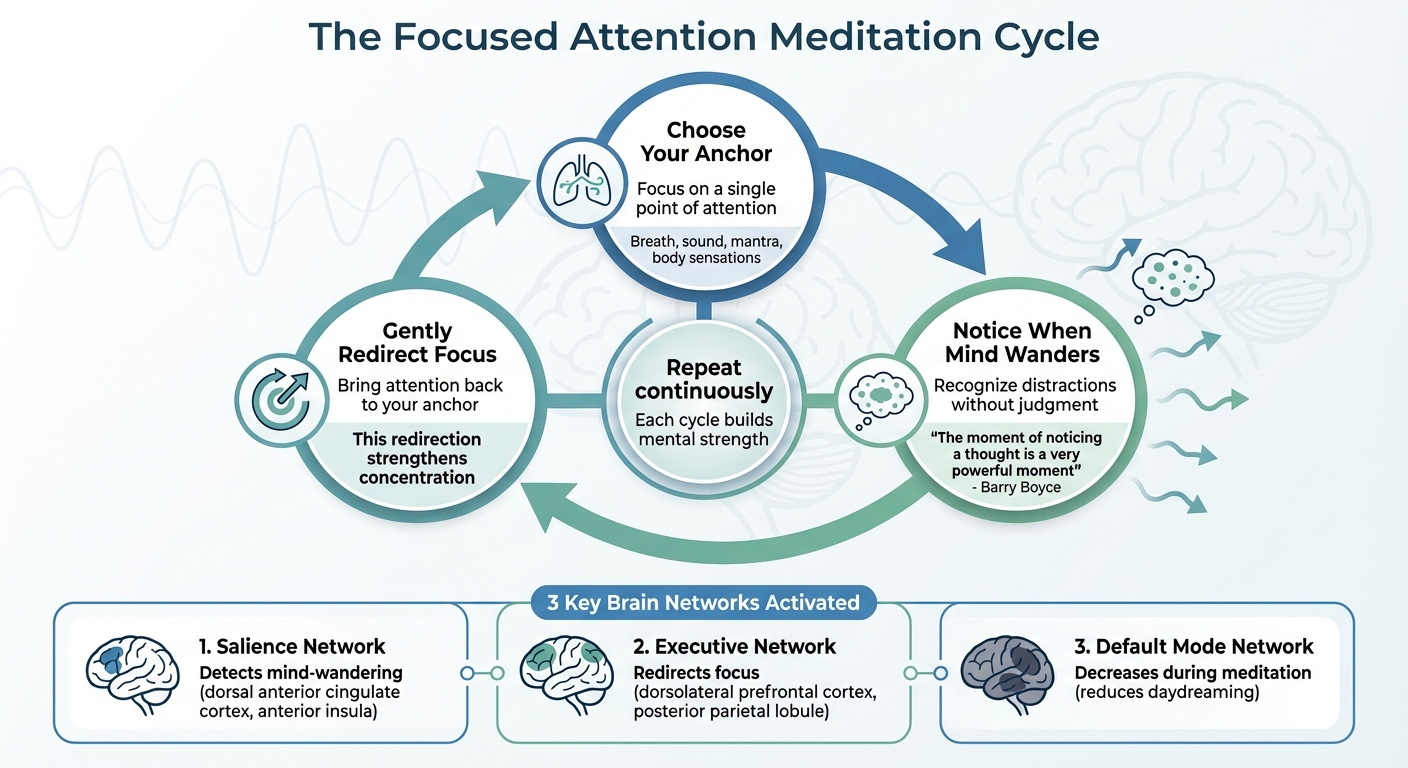
How Focused Attention Meditation Works: The 3-Step Concentration Cycle
Focused attention meditation (FAM), often called concentration meditation, is all about training your mind to stay centered on a single target. The process is straightforward: choose an anchor (like your breath), notice when your mind begins to wander, and gently bring your focus back. It's not about achieving perfect concentration or completely clearing your mind. Instead, it's about honing the ability to recognize distractions and refocus. This simple cycle forms the backbone of FAM and lays the groundwork for its broader benefits.
The main goal of FAM is to build sustained attention, helping to quiet that constant inner chatter. Over time, this skill can prepare you for deeper and more reflective meditation practices.
Core Elements of the Practice
Every FAM session revolves around two key components: selecting an anchor point and practicing gentle redirection.
Your anchor is the focus of your attention. Most people choose their breath because it’s always accessible. As Barry Boyce, Founding Editor of Mindful, explains:
"The nice thing about the breath is that it's reliable. It's always going to be there if we're alive."
You might focus on the sensation of air moving through your nostrils, the rise and fall of your chest, or the pause at the end of an exhale. While the breath is a popular choice, other anchors - like a mantra, body sensations, or ambient sounds - can work just as well. The key is to pick something consistent that supports your practice.
Interestingly, noticing when your mind drifts isn’t a failure - it’s a success. As Barry Boyce puts it:
"The moment of noticing a thought is a very powerful moment. It's really where the real meditation occurs. That's because there's a spark of insight at that point... you're aware of your thought process, not just caught up in it."
When this happens, simply acknowledge the thought without judgment and gently guide your focus back to your anchor. This act of redirection is what strengthens your concentration over time.
How It Differs from Other Meditation Methods
Focused attention meditation strengthens concentration by repeatedly bringing your focus back to a single point. This sets it apart from open-monitoring meditation, which involves observing all thoughts and sensations as they arise, without clinging to or judging them. Studies suggest that FAM boosts convergent thinking - helping you zero in on specific solutions to defined problems - while open-monitoring meditation is associated with divergent thinking, which encourages brainstorming and generating fresh ideas.
Another distinct practice is loving-kindness meditation, also known as Metta. This approach focuses on nurturing compassion and goodwill by repeating positive affirmations for yourself and others. Unlike FAM, which uses a neutral anchor like the breath, loving-kindness meditation specifically aims to cultivate emotional warmth and connection.
At its core, focused attention meditation provides a strong starting point. Once you’ve developed the ability to sustain focus on one thing, it becomes easier to explore and benefit from other meditation styles. This foundational skill of concentration opens the door to a richer, more varied meditation practice.
How Focused Attention Meditation Improves Concentration
Practicing focused attention meditation regularly can reshape how your brain manages attention. Studies reveal that this form of meditation enhances three key mental skills: monitoring (staying alert to distractions), disengaging (letting go of those distractions), and redirecting (bringing your focus back to a chosen point of attention). These strengthened abilities lead to noticeable improvements in tasks requiring concentration.
Cognitive Function Improvements
The benefits to cognitive performance are measurable. A 16-week study conducted in February 2012 at Liverpool John Moores University tested 40 individuals with no prior meditation experience. After just three hours of initial training, participants meditated for 10 minutes daily. Using a computerized Stroop task - a widely used test for attention control - researchers observed significant improvements in how participants focused and processed information.
Peter Malinowski, a researcher at Liverpool John Moores University, highlighted how meditation helps reallocate attention resources more effectively. This means your brain learns to direct its energy more precisely, enhancing sustained attention during tasks like working, reading, or engaging in conversations.
Brain Changes That Support Better Focus
Meditation doesn’t just improve cognitive function - it also rewires brain networks. Focused attention meditation activates three major brain systems that work together to maintain concentration. The salience network (involving the dorsal anterior cingulate cortex and anterior insula) detects when your mind starts to wander, while the executive network (including the dorsolateral prefrontal cortex and posterior parietal lobule) helps redirect focus to your chosen point of attention. At the same time, activity in the default mode network - associated with mind-wandering and daydreaming - decreases during meditation.
EEG studies provide further evidence of brain changes. Meditation shifts brain responses, both early (160–240 ms, N2) and later (310–380 ms, P3), reflecting more efficient use of mental resources. Over time, this efficiency makes concentrating feel easier and more natural.
Long-term meditators offer additional insights. Research has identified an inverted U-shaped curve in brain activation. For example, individuals with around 19,000 hours of meditation practice show stronger activation in attention-related brain areas compared to beginners. However, those with 44,000 hours of experience display reduced activation, suggesting that concentration eventually becomes effortless. As Antoine Lutz from the Waisman Laboratory for Brain Imaging and Behavior explains:
"The 'effortful' selection or 'grasping' of an object as primary focus is gradually replaced by the 'effortless' sustaining of an awareness without explicit selection".
The good news? You don’t need thousands of hours to see results. The Liverpool study demonstrated meaningful improvements with just 10 minutes of daily practice over 16 weeks. Over time, meditation helps your brain allocate attention more effectively, making focus feel less like a struggle and more like second nature.
How to Practice Focused Attention Meditation
Setting Up Your Meditation Space
Find a quiet, private spot where you won’t be interrupted. It could be a cozy corner of your bedroom, a dedicated room, or even a tranquil outdoor space. Keep the area tidy to minimize distractions, and opt for natural light or soft lighting instead of sitting in the dark. To avoid clock-watching, set a timer - your phone or a kitchen timer works perfectly. Start small with 5–10 minutes to ease into the practice without feeling overwhelmed.
Sit in a way that feels comfortable yet upright. You can use a chair with your feet flat on the ground, sit cross-legged on a cushion, or even meditate in bed if that feels calming. The key is to keep your back straight but relaxed, allowing your spine’s natural curve to support smooth, clear breathing. Rest your hands on your thighs, keep your upper arms parallel to your torso, and let your shoulders relax.
The Basic Technique
Once your meditation space is ready, focus entirely on a single point of attention - your "anchor." The most common anchor is your breath, such as the sensation of air moving through your nostrils or the rise and fall of your chest. Other options include focusing on a candle flame, a specific sound, or repeating a phrase. The goal is to stay present with the sensation itself, without overthinking it.
As you meditate, direct all your attention to this anchor. It’s natural for your mind to wander - this happens to everyone. When you notice your thoughts drifting to something else, gently acknowledge it without judgment and bring your focus back to your anchor.
Barry Boyce, Editor-in-Chief of Mindful, highlights the importance of this moment:
"The moment of noticing a thought is a very powerful moment. It's really where the real meditation occurs."
Creating a Consistent Practice
Begin with short sessions and gradually increase the duration as your ability to concentrate improves. Establishing a routine - like meditating at the same time each day - makes it easier to stick with the practice. Whether it’s morning to set a calm tone for the day or evening to unwind, consistency is key. Research suggests that just 12 minutes of daily practice can enhance your attention span.
Use small reminders to help make meditation a habit. For example, you could meditate right after your morning coffee or tie it to another daily ritual. Meditation teacher Sharon Salzberg underscores the importance of simply starting:
"The most important moment in your meditation practice is the moment you sit down to do it. Because right then you're saying to yourself that you believe in change, you believe in caring for yourself."
With a consistent routine and these steps in place, you’ll be ready to tackle common challenges and deepen your practice.
Common Challenges and How to Handle Them
Working with a Wandering Mind
It’s completely normal for your mind to wander during practice - it’s just part of being human. When you catch yourself replaying thoughts or getting distracted, pause for a moment and acknowledge it. A helpful technique is mental noting: silently label what’s pulling your attention. For example, if you’re thinking about work, you might note it as "mental talk." If a car drives by and grabs your focus, label it "sound". This simple act of acknowledgment creates a bit of space between you and the distraction, making it easier to refocus on your breath. When your mind drifts, gently guide it back without being hard on yourself. This process of noticing and redirecting builds the concentration skills we’ve talked about earlier.
Of course, recognizing distractions is one thing, but dealing with the frustration they sometimes bring is another hurdle, but there are quick mindfulness tools to help.
Handling Frustration During Practice
Frustration often sneaks in when you think a wandering mind means you’re failing. But here’s the truth: simply noticing those distractions is a step forward. As Barry Boyce explains:
"One of the wonderful things about meditation is the fact that it allows for such a monumental amount of failure. Failure is just fine."
Even if your entire 12-minute session feels like one long distraction and you only realize it at the end, that moment of awareness is still a win.
The idea of a "perfect" meditation session? It’s a myth. Instead of chasing perfection, focus on the small victories. Each time you notice your mind wandering and bring it back, you’re strengthening your ability to focus - like doing reps at the gym. Once your session ends, skip the self-critique. Don’t label it as "good" or "bad." Just acknowledge that you showed up, and carry on with your day.
Using The Mindfulness App to Support Your Practice
Guided Meditations for All Levels
The Mindfulness App provides access to over 500 guided meditations designed to help sharpen your focus and deepen your mindfulness journey. Whether you're just getting started or have years of experience, there's something tailored to your level.
For beginners, the "Mindfulness for Beginners" program introduces key concepts like natural awareness - observing the world without judgment - and meta-awareness, which involves recognizing your own thought patterns [2,6]. These sessions offer a structured approach to help you build focus and establish a steady practice through mindful habit formation [6,17]. If you're more advanced, programs like the "7 Days of Focus" series and "Deep Concentration" sessions are designed to refine your mental clarity. There are even specialized "Distraction" meditations to help you stay centered, even in chaotic or noisy environments.
The app also allows you to explore various focal points, such as your breath or surrounding sounds, so you can find what works best for you. With session lengths ranging from one to 10 minutes, it’s easy to fit meditation into even the busiest schedule.
These guided meditations lay the groundwork for a consistent mindfulness practice, which is further supported by the app’s built-in tools for staying on track.
Features That Help You Stay Consistent
Once you’ve established a routine, staying consistent becomes more manageable with the app’s thoughtful features. Progress tracking allows you to see how often and how long you meditate, giving you a visual record of your journey. Personalized meditation programs are tailored to your specific needs and goals, ensuring your practice feels relevant and rewarding.
One especially convenient feature is offline access - you can download sessions and meditate anywhere, even without an internet connection. The app is also available in 12 languages, making it accessible to users around the globe. With a 14-day free trial, you can explore everything the app offers and decide if it aligns with your routine before committing to a subscription.
Conclusion
Focused attention meditation helps train your brain to stay concentrated. Each time you notice your mind wandering and bring your focus back - whether to your breath, a sound, or another anchor - you’re strengthening the neural pathways that support sustained attention. Research highlights that practicing just 10 minutes a day for 16 weeks can lead to measurable improvements in attentional control markers. Over time, this practice also fosters meta-awareness, allowing you to observe your thoughts without getting entangled in them. This skill lays the groundwork for establishing a consistent meditation habit.
What matters most is sticking to a routine. Start small with 5–10 minute daily sessions instead of aiming for infrequent, longer practices. Barry Boyce, Founding Editor of Mindful, emphasizes the value of this process:
"The moment of noticing a thought is a very powerful moment. It's really where the real meditation occurs. That's because there's a spark of insight at that point... you're aware of your thought process, not just caught up in it."
For those looking for guidance, The Mindfulness App offers a variety of tools to support your meditation journey. With over 500 guided meditations designed for all experience levels, progress tracking, and offline access, the app makes it easier to stay consistent. Their 14-day free trial lets you explore programs like "Mindfulness for Beginners" or "7 Days of Focus" to find what works best for you. By removing common obstacles, the app helps ensure your practice stays steady and effective.
Focused attention meditation doesn’t just improve your focus during sessions - it sharpens your ability to concentrate in everyday life as well. With regular practice and the right tools, you can build a lasting habit that enhances your mental clarity and awareness.
FAQs
How can focused attention meditation enhance concentration and mental clarity?
Focused attention meditation is all about honing your ability to concentrate on one thing - whether it's your breath, a sound, or an object. By practicing this regularly, you train your brain to manage distractions more effectively, which can lead to better focus and sharper mental clarity over time.
This type of meditation works by strengthening the neural pathways responsible for attentional control. Over time, this can enhance overall cognitive performance, making it easier to stay present and engaged in daily life. If you're looking for some extra guidance, The Mindfulness App offers helpful guided sessions that can simplify the process and make it easier to build this habit into your routine.
How is focused attention meditation different from other meditation styles?
Focused Attention Meditation (FAM) is a practice designed to train your mind to focus on a single point, like your breath or a specific sound. When your attention inevitably wanders, you gently guide it back to that focal point. This approach differs from mindfulness meditation, which emphasizes open awareness of the present moment without anchoring to any one object.
The main purpose of FAM is to sharpen concentration and minimize distractions, making it an excellent choice for anyone looking to improve their ability to focus. Other meditation styles have different goals: loving-kindness meditation emphasizes developing compassion, while mantra-based practices aim to create a state of effortless mental stillness.
What sets FAM apart is its effect on the brain. It strengthens the neural networks responsible for attention, boosting mental clarity and focus. If you're interested in trying FAM, guided sessions are available through The Mindfulness App to help you develop this skill step by step.
What’s the best way to start focused attention meditation as a beginner?
Starting focused attention meditation can be straightforward and rewarding when approached with a few simple steps. First, pick a single point of focus - this could be your breath, a soft sound, or even the sensation of your body sitting still. Find a comfortable position to sit in, keeping your back straight and your shoulders relaxed. To keep things manageable, set a timer for 5–10 minutes.
During your meditation, gently bring your attention to the focus you've chosen. If your thoughts start to wander (and they will - it’s natural), simply notice the distraction without judgment and guide your mind back to your focus. This practice of returning to your point of attention helps strengthen your concentration over time. When the timer signals the end, take a quiet moment to notice how you feel before easing back into your daily routine.
For extra support, you might explore beginner-friendly resources like The Mindfulness App, which offers guided meditations and courses to help you develop a steady practice and improve your focus.
.jpeg)