

Mental health benefits are now a workplace must-have. Here's why:
- 92% of U.S. workers value companies prioritizing emotional well-being.
- 30% of employees would trade a pay cut for better mental health support.
- Mental health issues like anxiety and depression cost $1 trillion globally in lost productivity each year.
For HR leaders, this means taking action to address compliance, improve benefits, and create a supportive environment. Key steps include:
- Ensure compliance with updated mental health regulations (e.g., MHPAEA).
- Evaluate and improve Employee Assistance Programs (EAPs) to boost usage.
- Introduce mindfulness and stress management tools to reduce burnout.
- Train managers to recognize mental health concerns and respond effectively.
- Communicate benefits clearly to increase employee awareness and usage.
- Measure and refine programs using employee feedback and performance metrics.
These actions not only support employees but also improve productivity and retention. Start by reviewing your current offerings and identifying gaps - small changes can make a big difference.
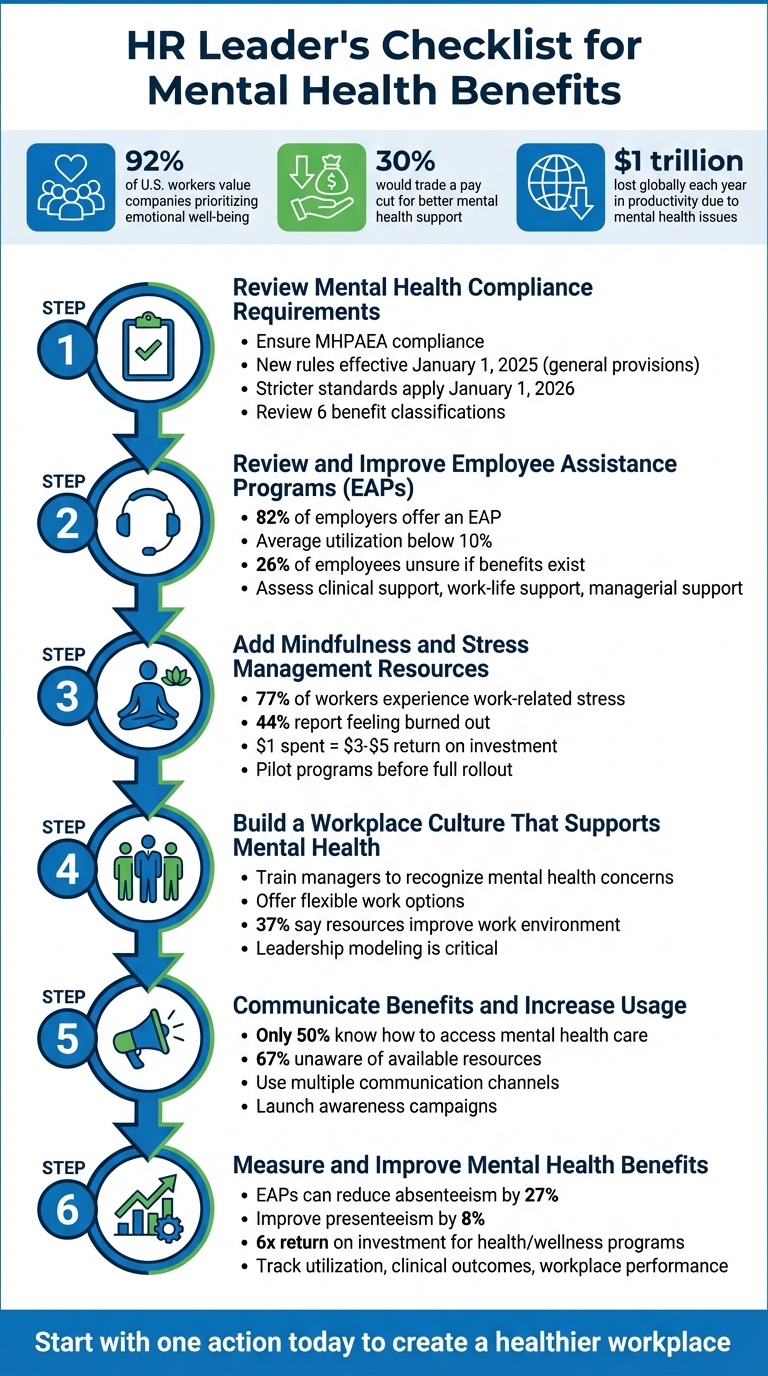
6-Step HR Checklist for Implementing Mental Health Benefits
What You Need to Know About Mental Health Benefits in the Workplace: The Mental Health Parity Law
Step 1: Review Mental Health Compliance Requirements
Make sure your organization aligns with all federal and state regulations concerning mental health coverage. The Mental Health Parity and Addiction Equity Act (MHPAEA) requires that health plans treat mental health and substance use disorder (MH/SUD) benefits the same as medical and surgical (M/S) benefits. As the U.S. Department of Labor explains: "The Mental Health Parity and Addiction Equity Act (MHPAEA) generally prevents most group health plans and health insurance issuers that provide mental health and substance use disorder (MH/SUD) benefits from imposing more restrictive coverage limitations on those benefits than on medical/surgical (M/S) benefits".
On September 9, 2024, new rules were introduced to strengthen these requirements. For plans operating on a calendar-year basis, the general provisions took effect on January 1, 2025. However, stricter measures, such as the "meaningful benefits" standard and mandatory evaluations of outcomes data, will apply starting January 1, 2026. Be sure your 2026 plans meet these updated standards.
Check Compliance with MHPAEA Standards
Start by auditing your health plans to confirm they meet MHPAEA requirements. Use the most recent version of the International Classification of Diseases (ICD) or the Diagnostic and Statistical Manual of Mental Disorders to define mental health conditions and substance use disorders. Take a close look at non-quantitative treatment limitations (NQTLs) - like preauthorization rules, step therapy protocols, or network standards - and ensure they’re applied equally to both MH/SUD and M/S benefits.
Document your NQTL analyses thoroughly. For ERISA plans, this documentation must include a certification that your organization followed a "prudent process" when selecting and overseeing the service providers conducting the analysis. If federal or state regulators request this documentation, you’ll need to provide it within 10 business days. If any compliance issues are found, you’ll have 45 calendar days to present a corrective action plan.
Once compliance is confirmed, shift your focus to identifying and addressing gaps in coverage.
Review Current Benefits for Coverage Gaps
Examine your benefits across six key classifications: in-network and out-of-network inpatient care, in-network and out-of-network outpatient care, emergency services, and prescription drugs. If your plan offers a core treatment for a medical diagnosis in any of these categories, it must also include a comparable treatment for MH/SUD in the same category. This "meaningful benefits" requirement became mandatory on January 1, 2026.
Pay close attention to outcomes data. Gather and analyze metrics like network adequacy, provider reimbursement rates, denial rates, and the number of providers accepting new patients. Compare these metrics for MH/SUD and M/S benefits to identify any significant disparities. If gaps are found, consider expanding your provider network or adjusting payment rates to improve access.
Step 2: Review and Improve Employee Assistance Programs (EAPs)
Once you've ensured regulatory compliance, it's time to take a closer look at your Employee Assistance Program (EAP). According to 2024 SHRM research, 82% of employers offer an EAP. Yet, with average utilization rates falling below 10% and 26% of employees unsure if their employer even provides mental health benefits, there’s a clear gap between what’s offered and what employees actually use. This disconnect highlights an opportunity to better support your workforce by refining your EAP.
Review Current EAP Services
Start by evaluating the services your EAP provides to ensure they meet essential needs. A well-rounded EAP should offer:
- Clinical support: This includes assessments, short-term counseling, referrals, and 24/7 crisis intervention.
- Work-life support: Services like financial counseling, legal assistance, elder care, child care, and adoption support.
- Managerial support: Tools such as supervisor training and consultations to help identify early signs of behavioral issues.
- Advanced digital tools: Features like AI-driven preventive care and burnout detection.
Next, assess whether your EAP provider follows current best practices. Forming a cross-departmental benefits committee can help ensure regular audits. Verify that the provider network includes diverse mental health professionals capable of addressing the needs of employees from various backgrounds and identities. If your workforce is geographically dispersed, confirm that the vendor can support employees across different locations and time zones. Once you’ve reviewed coverage, focus on improving how employees access and engage with these services.
Improve Access and Awareness
An EAP is only effective if employees know about it and can use it easily. Research shows that less than 53% of workers understand how to access their mental health benefits, which contributes to low participation rates. This lack of awareness has tangible consequences - employees who are informed about their mental health resources are 10 percentage points more likely to stay with their current employer.
To boost awareness, go beyond onboarding materials. Regularly promote your EAP through lunch-and-learn sessions, open enrollment events, and information sessions. Use a variety of communication channels, such as newsletters, town halls, and employee portals, to engage different age groups and preferences. Reframe your EAP as a proactive tool for handling everyday challenges, not just a resource for crises. Training managers to recognize behavioral changes and guide employees toward resources is also crucial. As Bhavik Shah points out:
"Managers must know exactly how to support their team without becoming clinicians or therapists."
Finally, tackle confidentiality concerns head-on. Many employees hesitate to use EAPs due to fears about privacy or career repercussions. Make it clear that scheduling appointments is safe and won’t negatively impact their job. This is not just about employee well-being - it’s also about financial health. For instance, annual medical costs are approximately $1,400 higher for employees who don’t utilize available well-being programs like EAPs. Improving access and awareness benefits everyone, from individual employees to the organization as a whole.
Step 3: Add Mindfulness and Stress Management Resources
Building on your enhanced EAP, it's time to broaden your wellness strategy by incorporating mindfulness and stress management tools. The need is clear: 77% of workers experience work-related stress, and 44% report feeling burned out. On top of that, 76% of U.S. workers have experienced at least one symptom of a mental health condition. These numbers highlight the urgency of providing support. Plus, investing in mental health makes financial sense - every $1 spent on mental health initiatives yields a $3 to $5 return.
Add Mindfulness Tools to Wellness Programs
Start by surveying your employees to identify their main stressors and preferences. This will help you avoid the issue of "option overload", where too many choices can overwhelm instead of helping. Streamline your offerings by consolidating mental health benefits under a few trusted, high-quality providers.
Before rolling out new mindfulness tools company-wide, pilot them with a small group of employees. This allows you to gather feedback and make adjustments based on real experiences. The benefits are clear: 94% of HR professionals believe mental health resources improve employee health, 88% say they boost productivity, and 86% report better retention rates. Train managers to recognize signs of stress in their teams and guide employees toward these resources. To break down barriers, encourage using mindfulness tools during work hours and make it clear that this practice is supported. You can take it a step further by integrating a dedicated mindfulness app into your wellness program.
Use The Mindfulness App for Employee Support
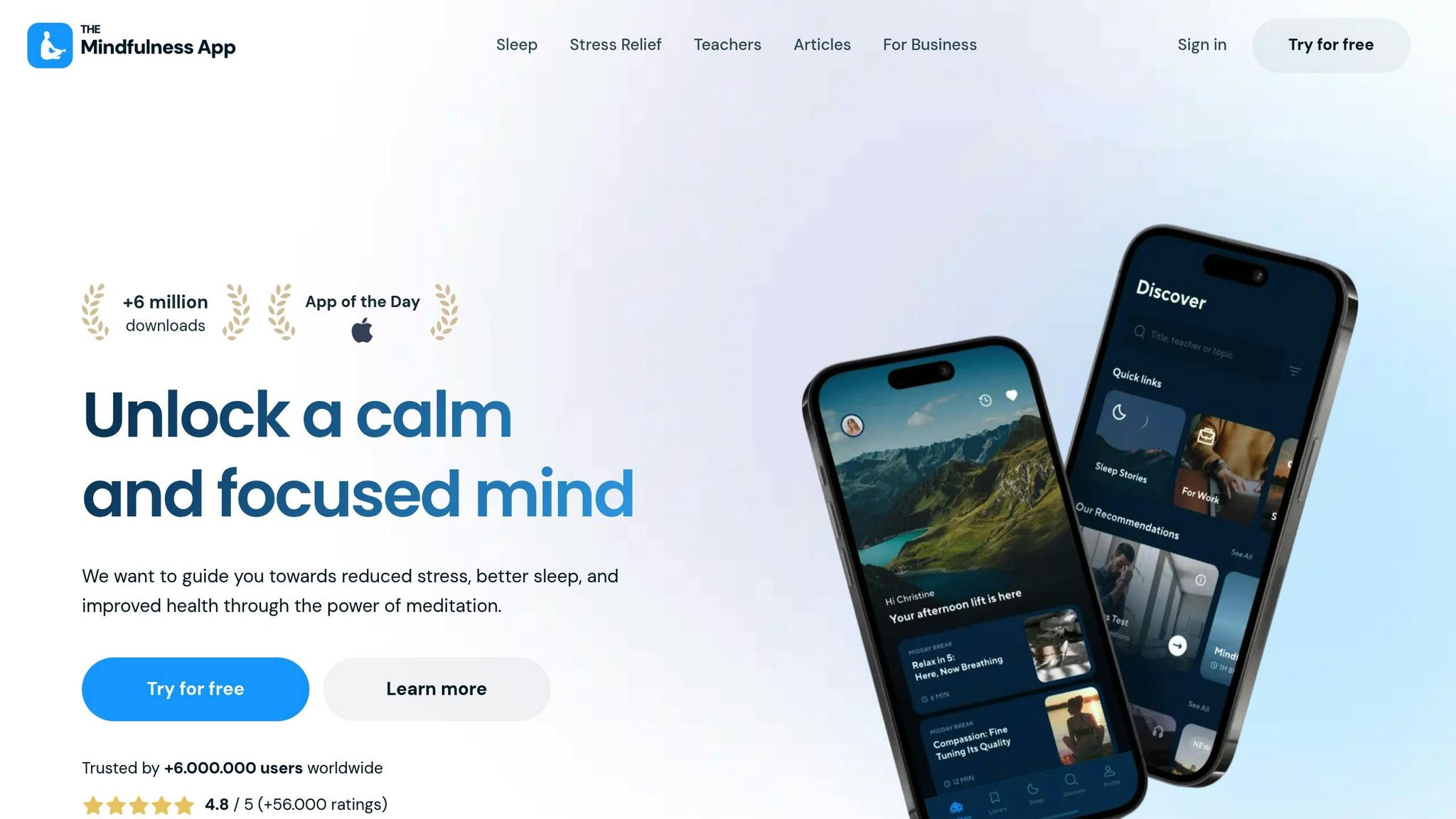
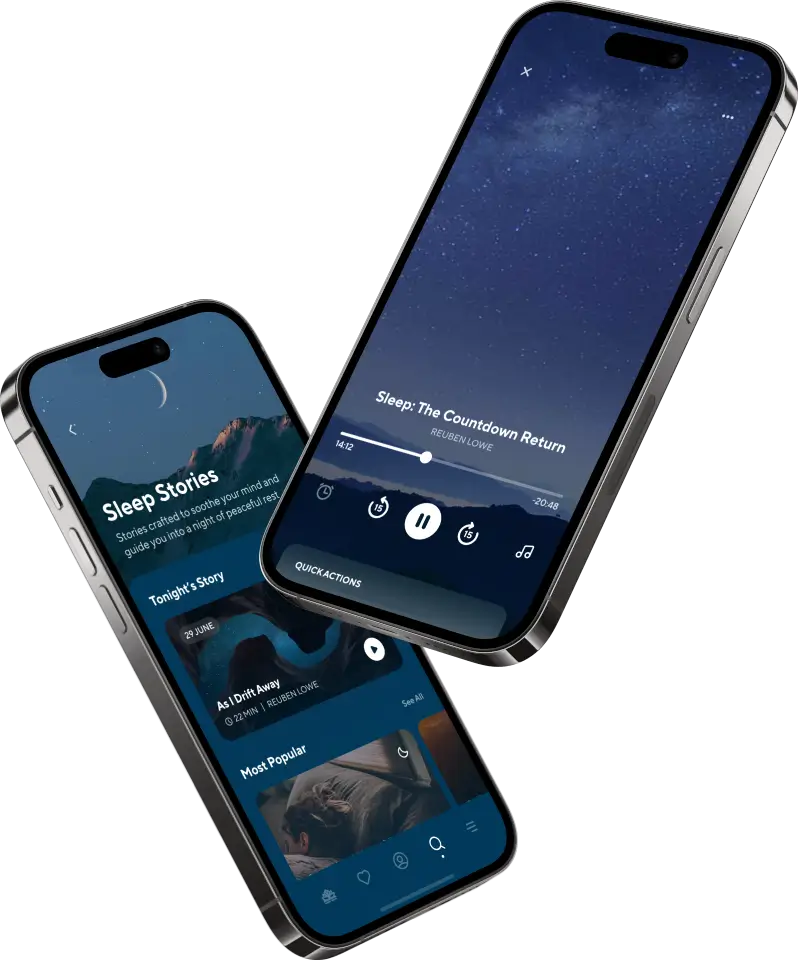
Once you've identified employee needs, digital tools can play a key role in providing mindfulness support. The Mindfulness App is an excellent option, offering over 500 guided meditations, sleep stories, and mindfulness courses in 12 languages. Employees can access personalized meditation programs anytime - whether they're at their desk, working remotely, or traveling. The app also features offline functionality, allowing users to download content and practice even without internet access.
To maximize engagement, make the app easy to find and use. Include it in your company intranet or wellness portal, and promote it through email, Slack, Microsoft Teams, and newsletters. Share success stories during town halls to reduce stigma and demonstrate its impact. Offering a 14-day free trial is another way to encourage employees to explore the app's premium features. When leadership openly uses and endorses mindfulness tools, it sets the tone for everyone else to feel comfortable doing the same.
"You can offer the most glamorous resources in the world, but if people don't feel psychologically safe, it won't work."
- Bhavik Shah
sbb-itb-bea8dce
Step 4: Build a Workplace Culture That Supports Mental Health
Having strong mental health benefits is just the beginning. To truly make a difference, organizations need a workplace culture that actively supports these initiatives. Benefits alone won't help if employees don’t feel safe using them. In fact, 37% of employees say that mental health resources from their employer improve the work environment. However, this only works when psychological safety is a priority. Bhavik Shah, a Culture Change Strategist, puts it perfectly:
"Strong culture is when things get hard, and you're still able to keep the promises and commitments you've made".
Train Managers to Recognize Mental Health Concerns
Managers are often the first to notice when employees are struggling. They’re not therapists, but they play a critical role in identifying signs like shifts in behavior, mood, or performance. Programs such as Mental Health First Aid (MHFA) equip managers with tools to respond effectively. Developing "mental health literacy" is essential. For example, managers can ask open-ended questions like, "How can we support you in changing these behaviors?" to encourage employees to seek help.
Investing in manager training has tangible benefits, such as lowering healthcare costs and boosting employee well-being. Training should also cover legal responsibilities, like adhering to ADA requirements for reasonable accommodations and understanding FMLA leave rights. When managers are equipped with this knowledge, they create a more adaptable and supportive workplace.
Offer Flexible Work Options
Once managers are trained, offering flexible work arrangements reinforces your commitment to mental health. Flexibility plays a major role in reducing burnout, which affected 44% of U.S. workers in 2024. Options like remote work, flexible schedules, and compressed workweeks allow employees to balance personal and professional responsibilities more effectively. Separating paid sick leave from vacation time also ensures employees can use leave for mental health without sacrificing days meant for rest or family time.
A real-world example of this is Gap, Inc., which introduced stable scheduling for 1,500 workers across 28 stores between 2015 and 2016. By posting schedules two weeks in advance and removing "on-call" shifts, they saw a 5% boost in productivity and a 7% increase in sales, amounting to an estimated $2.9 million in additional revenue.
For salaried employees, policies like a "right to disconnect" can make a big difference. This might include using delayed email sends after work hours or setting company-wide mental health days. Leaders who model healthy behaviors - like taking their own vacation days and limiting after-hours communication - send a powerful message to their teams. Combining flexible work policies with well-trained managers creates a workplace where mental health truly thrives.
Step 5: Communicate Benefits and Increase Usage
Once you've refined your benefits offerings, the next challenge is making sure employees know about them - and feel comfortable using them. A shocking reality is that only 50% of employees know how to access mental health care through their employer-sponsored insurance. Even worse, 67% of workers are unaware or only somewhat aware of the mental health resources their company provides.
This gap often stems from how HR teams communicate these benefits. Casey Hauch, Managing Director of Employee Experience at Willis Towers Watson, puts it plainly:
"HR teams often use technical program names that may not resonate with employees. Employees don't think this way, so you have to put yourself in an employee's shoes and meet them where they are."
Instead of saying, "We offer an EAP", explain how the program helps with real-life situations - like support for new parents, guidance during natural disasters, or assistance in caring for aging relatives. Use simple, relatable language, steering clear of insurance jargon. During onboarding, go beyond handing out a benefits booklet. Show employees how to navigate the insurance portal and locate an in-network therapist. Reinforce these messages at 30, 60, and 90 days to ensure the information sticks. Clear, consistent communication is just as important as the benefits themselves - it’s what turns awareness into action.
Create a Clear Communication Plan
A solid communication plan should answer four key questions: Why would I use this? How do I access it? Who can I contact with questions? Where do I find more details? A one-page cheat sheet that addresses these questions - while emphasizing confidentiality - can be a game-changer.
To reach employees effectively, use multiple channels like email, messaging apps, and virtual office hours. Google's "Blue Dot" program is a standout example of this approach. The initiative trained over 2,000 employees to provide peer support, making them easily identifiable by blue dot stickers on laptops, name badges, and email signatures.
Use Awareness Campaigns to Reduce Stigma
Awareness campaigns are another powerful way to promote benefits while breaking down stigmas. National events like Mental Health Awareness Month in May or World Mental Health Day in October are excellent opportunities to launch these campaigns. The most impactful campaigns feature leadership involvement. When executives openly share their mental health journeys or take mental health days, it sends a strong message that seeking help is encouraged - not frowned upon.
For example, Eventbrite introduced a policy where all employees take the first Friday of each month off for self-care and family time. Similarly, Jacobs Engineering Group trained over 2,000 employees, including executives, as "mental health champions" to provide peer support. These visible efforts address a critical issue: eight in 10 workers say shame and stigma stop them from seeking treatment. By combining education, leadership modeling, and peer support, awareness campaigns can foster a workplace culture where employees feel safe and supported in accessing resources.
Step 6: Measure and Improve Mental Health Benefits
Launching mental health initiatives is just the beginning. To truly make an impact, you need to track how these programs perform and continuously refine them. Erin Terkoski Young, Senior Director of Health, Equity & Wellbeing at WTW, puts it clearly:
"Performance measurement is the 'what,' and the program evaluation is the 'how.' Together they represent the value of your mental health program".
The stakes are high. Anxiety and depression account for a staggering $1 trillion in lost productivity globally each year. On the flip side, organizations that invest wisely in health and wellness often see a 6x return on their investment. The difference between success and falling short often lies in measuring the right metrics - and acting on the insights they provide.
Use Employee Surveys to Identify Needs
One of the best ways to understand employee needs is to ask them directly. For example, Kent State University used employee surveys to uncover critical issues, leading to significant cost savings.
Focus on actionable questions like, "How often do you feel stressed at work?" or "Do you feel your workload is manageable?". For honest feedback, create a psychologically safe environment - anonymous surveys can help. This is crucial, as 67% of workers are unaware or only somewhat aware of the mental health resources their employer offers.
But don’t stop at numbers. If you notice trends like low usage of paid time off, dig deeper. Talk with employees to uncover the cultural or workload barriers preventing them from taking breaks. Use focus groups, one-on-one interviews, or mental health ambassadors to get the full picture. Transparency is key - share your findings with employees and outline the steps you’ll take to address their concerns. This not only builds trust but also demonstrates that their input drives real change. These efforts help identify gaps and guide improvements, showing your commitment to employee well-being.
Track Metrics to Measure Program Performance
Once you’ve gathered feedback, it’s time to measure the actual impact of your programs. Data is essential. For instance, effective Employee Assistance Programs (EAPs) can reduce absenteeism by 27% and improve presenteeism by 8%. Tracking metrics like these helps you evaluate whether your programs are hitting their goals.
Start by monitoring engagement and utilization rates. High awareness is reflected in utilization rates exceeding the 5–10% benchmark. But low usage doesn’t always mean low need. As Robyn Harmon, Director at Willis Towers Watson, explains:
"Even if EAP utilization is low, that's not necessarily a good indicator of what the need is in the population. It could be a factor of challenges with navigation, access to good care, stigma, finding that right provider".
To measure clinical outcomes, use validated tools like GAD-7 and PHQ-9 to track reductions in symptoms. Keep an eye on workplace performance metrics such as absenteeism, presenteeism, and regretted turnover (losing top performers). Also, evaluate access metrics like average time to get an appointment and whether services are equitably available across all demographics and remote locations. Many organizations now track "Burnout Risk" and "Psychological Safety" as early indicators of retention and productivity.
Here’s a shift worth noting: 61% of companies now prioritize employee needs and program innovation over traditional financial ROI when evaluating success. Instead of just crunching numbers, look at the broader "Value of Investment" (VOI), which includes employee morale, psychological safety, and workplace culture. Break down data by department, job type, and location to identify hotspots where burnout or turnover are most acute. Quarterly pulse surveys are another effective tool - they let you track engagement and burnout risk in real-time, rather than waiting for an annual review. The goal? Address issues early before they escalate into bigger challenges.
Conclusion
This checklist connects compliance with care, offering a clear path to create a mental health program that genuinely supports employees. By following these steps, businesses can see real improvements in productivity, retention, and the overall workplace environment.
The case for action is strong: companies that focus on mental health often experience reduced absenteeism, higher engagement, and lower healthcare costs. Yet, challenges remain. The gap between providing benefits and employees actually using them often hinges on clear communication, fostering psychological safety, and leadership's active involvement.
"Strong culture is when things get hard, and you're still able to keep the promises and commitments you've made".
Bhavik Shah’s insight highlights an essential truth: staying committed to mental health initiatives during tough times shows employees that their well-being is a priority. This builds trust and strengthens the organization’s resilience. Taking steps to support mental health today helps lay the groundwork for a more engaged and productive future.
Start with just one action today. Whether it’s reviewing current benefits for gaps, introducing manager training, or improving communication about existing resources, each step brings you closer to creating a workplace where employees feel valued. After all, 92% of U.S. workers say it’s important to be part of an organization that prioritizes emotional and psychological well-being. Take the first step now to foster a healthier, more resilient workplace.
FAQs
How can HR leaders stay compliant with current mental health regulations?
HR leaders have a responsibility to keep up with federal and state laws, like the Mental Health Parity and Addiction Equity Act (MHPAEA). This means ensuring that mental health benefits are no more restrictive than those for medical or surgical care. It also requires maintaining thorough documentation to prove compliance.
Regularly checking updates from trusted sources, such as the Department of Labor or the Department of Health and Human Services, is a smart way to stay ahead of changes. Offering ongoing training for HR teams and leadership on legal requirements, along with using compliance checklists, can make these efforts more manageable. By staying informed and prepared, organizations can promote adherence to regulations while also cultivating a workplace that prioritizes mental well-being.
How can HR leaders encourage employees to use mental health benefits?
Start by making mental health resources a key part of the onboarding process. Clearly explain what benefits are available, why they’re important, and how employees can access them. Include this information in both digital and printed formats to ensure everyone gets the message.
Keep awareness alive with regular reminders. These could be follow-ups after onboarding or quick mentions during performance reviews. Offering clear, step-by-step instructions - like finding in-network providers or signing up for mindfulness programs - can make these benefits feel accessible and easy to use.
Another powerful step is training managers to talk about mental health in an open and supportive way. When leaders normalize these conversations, it creates a workplace culture where employees feel safe seeking the help they need.
How can HR leaders incorporate mindfulness and stress management tools into workplace wellness programs?
HR leaders can improve workplace wellness programs by incorporating mindfulness and stress management tools into their mental health strategies. For example, offering access to mindfulness apps like The Mindfulness App can help employees manage daily stress and support their overall well-being.
To maximize the impact, these tools can be integrated with existing Employee Assistance Programs (EAPs) and wellness platforms. This approach makes it easier for employees to identify stress-related challenges and find resources tailored to their needs. Hosting mindfulness training sessions, encouraging consistent practice, and weaving stress management techniques into company wellness policies can further promote a culture that values mental health.
These efforts can make mindfulness a natural part of the workplace, boosting employee engagement and fostering a healthier, more balanced work environment.