

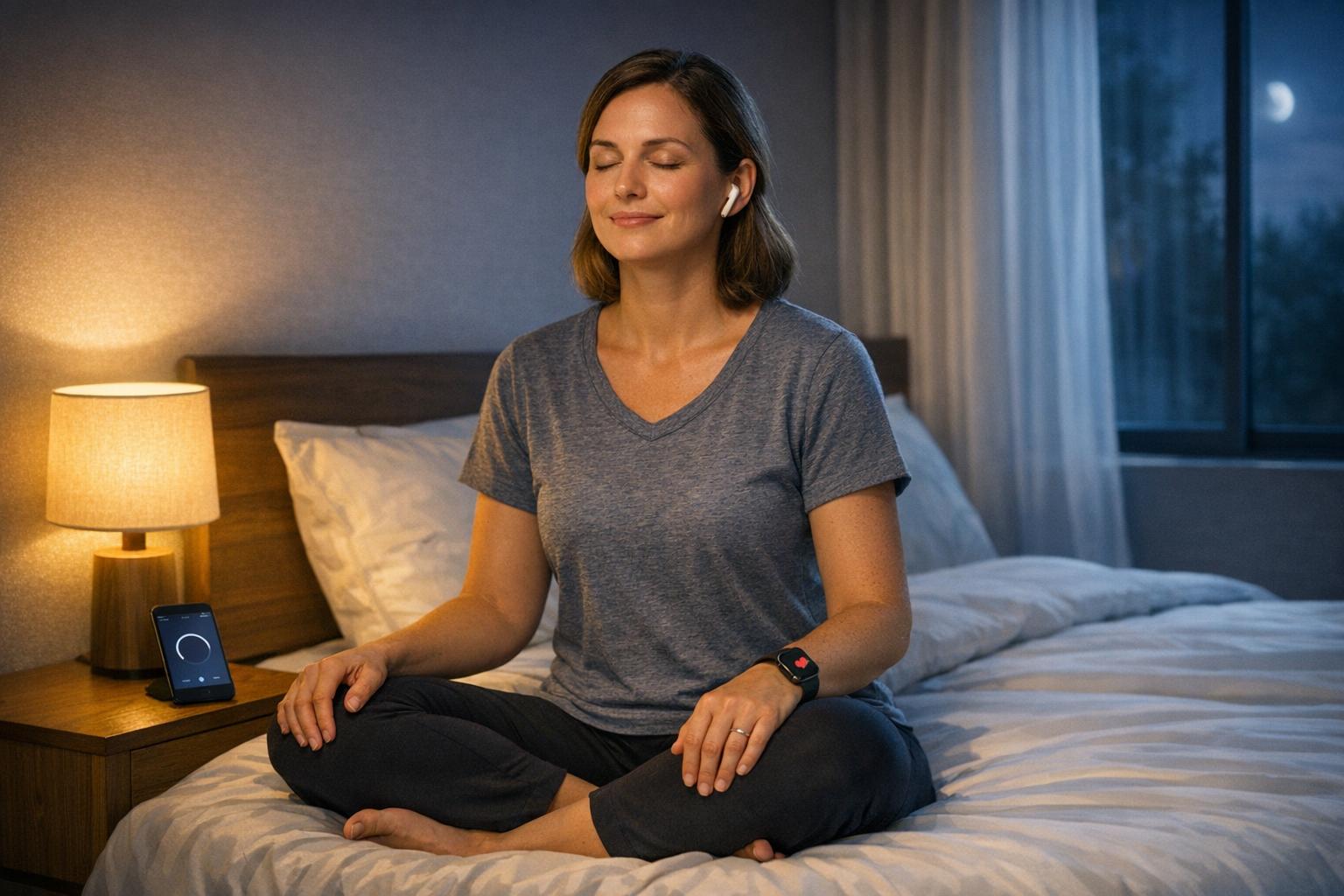
If you’re lying awake at night with racing thoughts, guided meditation can help. Research shows it reduces anxiety and improves sleep quality by calming your mind and body. Studies highlight mindfulness practices as more effective than standard sleep tips, cutting nighttime worry and pre-sleep arousal. Even short, consistent sessions of 10 minutes can make a difference, helping you relax and fall asleep faster.
Key findings include:
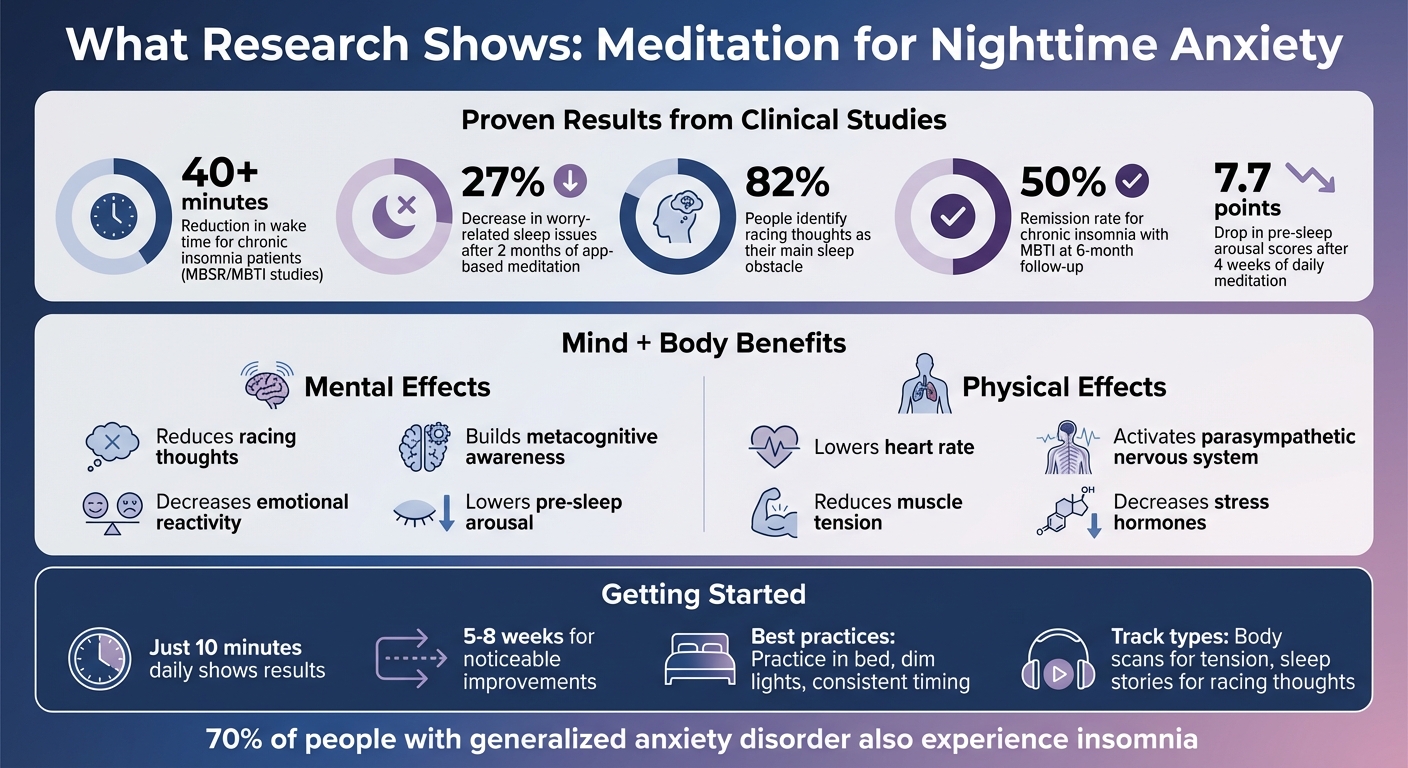
- Mindfulness meditation reduces wake time by over 40 minutes in chronic insomnia cases.
- App-based programs cut worry-related sleep issues by 27% in two months.
- Meditation lowers heart rate, eases muscle tension, and reduces stress hormones.
To get started, choose guided meditations tailored to your needs - like body scans for tension or sleep stories for racing thoughts - and build a simple bedtime routine. Apps like The Mindfulness App offer tools to help you unwind and sleep better.
Meditation for Sleep: Key Research Findings and Benefits
Does Meditation Improve Sleep? 👍 YES! Research Shows + 3 Meditation Techniques to Fall Asleep Fast
sbb-itb-bea8dce
What the Research Shows
The studies below demonstrate how guided meditation can measurably improve sleep quality and reduce anxiety.
Over the last ten years, numerous trials have shown that meditation not only enhances sleep but also alleviates nighttime anxiety. The findings highlight that mindfulness-based methods consistently outperform conventional approaches, leading to noticeable improvements in both sleep quality and anxiety levels.
Mindfulness Awareness Practices vs. Sleep Hygiene Education
A 2015 randomized trial compared two strategies: Mindfulness Awareness Practices (MAPs) and standard Sleep Hygiene Education (SHE). Results showed that the MAPs group experienced significant improvements in sleep quality scores, while those who only received sleep hygiene tips saw less progress. Additionally, participants practicing MAPs reported reduced levels of insomnia, depression, and fatigue compared to the SHE group.
This distinction is important. Sleep hygiene focuses on external factors like controlling room temperature or limiting caffeine, whereas mindfulness addresses the internal mental patterns that disrupt sleep. By training individuals to observe and detach from racing thoughts, MAPs help tackle the underlying causes of nighttime anxiety rather than merely treating its symptoms.
Next, let’s look at meditation’s role in managing chronic insomnia.
MBSR and MBTI for Chronic Insomnia
Between 2008 and 2012, Dr. Jason C. Ong conducted a trial with 54 participants suffering from chronic insomnia. The study compared three groups: Mindfulness-Based Stress Reduction (MBSR), Mindfulness-Based Therapy for Insomnia (MBTI), and a self-monitoring control group. Results showed that participants in the meditation groups reduced their total wake time by 43.75 minutes, while the control group only reduced wake time by 1.09 minutes.
At the 6-month follow-up, MBTI demonstrated a 50% remission rate and a 78.6% treatment response rate. MBTI, which integrates meditation with behavioral techniques like sleep restriction and stimulus control, proved especially effective. Dr. Ong summarized his findings:
Mindfulness meditation appears to be a viable treatment option for adults with chronic insomnia and could provide an alternative to traditional treatments for insomnia.
Additionally, meditation significantly reduced Pre-Sleep Arousal Scale (PSAS) scores by 7.13 points, compared to just 0.16 points in the control group.
Studies on Clinical Populations
Research focusing on individuals with anxiety disorders has yielded similarly encouraging results. For example, a trial conducted by Brown University from July 2019 to February 2020 involved 71 individuals prone to high levels of worry. Participants used the "Unwinding Anxiety" app for 10 minutes daily over two months. The mindfulness group reported a 27% reduction in worry-related sleep disturbances, compared to only 6% in the "treatment as usual" group. The improvements were linked to increased emotional non-reactivity - an enhanced ability to notice anxious thoughts without becoming overwhelmed by them.
More recently, a study from the University of Tokyo (September 2023–May 2024) tested an 8-week app-based meditation program with 51 working women. Participants wore Fitbit Sense 2 devices to monitor physiological changes. The group practicing meditation showed a notable reduction in Insomnia Severity Index scores (b = -1.55, p = .013) and a measurable decrease in their daily resting heart rate compared to the control group.
In another example, a 2025 pilot study from Harvard Medical School tracked 13 individuals with chronic insomnia who used the Calm app for 10–30 minutes at bedtime over four weeks. Led by Dr. Yan Ma, the study reported a 7.7-point drop in pre-sleep arousal and a 4.5-point improvement in insomnia severity. Across various clinical populations - from those with generalized anxiety to chronic insomnia sufferers - the evidence consistently shows that guided meditation delivers measurable benefits for both sleep quality and nighttime anxiety.
How Guided Meditation Reduces Nighttime Anxiety
When you’re tossing and turning at night, unable to sleep, it’s often because your body is stuck in "fight-or-flight" mode. Even though there’s no real danger, your nervous system doesn’t get the memo. Guided meditation works by calming your mind and body through both mental and physical pathways, creating the conditions needed for restful sleep.
Lowering Presleep Arousal
Nighttime anxiety often stems from racing thoughts. In fact, a survey of over 8,600 meditation app users revealed that 82% identified racing thoughts as the main cause of their sleep issues.
Meditation helps by building metacognitive awareness - the ability to notice your thoughts without getting caught up in them. As Dr. Judson A. Brewer from Brown University's Mindfulness Center explains:
Developing metacognitive awareness may help individuals to notice body sensations and hyperarousal without exacerbating the inability to sleep due to frustration.
This approach is critical, especially since about 70% of people with generalized anxiety disorder also experience insomnia. By stepping back from your thoughts, you can reduce their emotional grip, making it easier to relax.
Physical tension also plays a big role in keeping you awake. Meditation increases body awareness, helping you recognize and release tension before it spirals out of control. This combination of emotional and physical relaxation has been linked to lower scores on the Pre-Sleep Arousal Scale, a tool used to measure presleep anxiety levels.
But the benefits of meditation go beyond calming your mind - it also triggers essential physical changes.
Triggering the Relaxation Response
Meditation doesn’t just quiet your thoughts; it actively shifts your body out of "fight-or-flight" mode and into a restorative state. This process, known as activating the parasympathetic nervous system, is key to preparing your body for sleep. Dr. Melissa Young from Cleveland Clinic highlights this point:
Making a conscious effort to calm your mind and be mindful before bed helps you actively shift your body into a parasympathetic (rest) mode.
This shift leads to several noticeable changes. For example, research involving working women found that daily app-based meditation significantly lowered both resting heart rates and heart rates during non-REM sleep.
Additionally, meditation helps counteract adrenaline, the hormone responsible for keeping you alert. By calming the sympathetic nervous system, meditation lowers your body’s stress response, which is particularly helpful for the one-third of adults who struggle with sleep issues at some point.
Here’s a breakdown of how these physiological changes impact sleep:
| Physiological Change | Impact on Sleep |
|---|---|
| Lowered Heart Rate | Signals the body to enter a restorative state |
| Slower Breathing | Reduces physical hyperarousal and anxiety |
| Parasympathetic Activation | Counteracts adrenaline and the "fight-or-flight" response |
| Reduced Muscle Tension | Eases discomfort that may delay sleep onset |
Together, these mental and physical effects make guided meditation a powerful tool for overcoming the barriers to restful sleep.
How to Use Guided Meditation at Bedtime
Understanding how meditation works is only half the battle - making it a regular part of your nighttime routine is where the real magic happens. The trick? Build a consistent routine that tells your body it's time to relax. Even dedicating just 5–10 minutes can make a noticeable difference.
Building a Consistent Bedtime Routine
Start preparing for sleep well before your head hits the pillow. According to clinical psychologist Dr. Holly Batchelder, "the best way to improve your sleep is to improve what you do in the morning". This means setting your internal clock with morning sunlight and physical activity, then gradually easing into relaxation as the day winds down.
Try the 90-60-30 rule for a smoother transition to bedtime:
- 90 minutes before bed: Dim the lights and take a warm bath.
- 60 minutes before bed: Turn off your screens and jot down any lingering worries in a journal.
- 30 minutes before bed: Practice deep breathing exercises in a cool, dark room.
When it’s time to meditate, do it lying in bed to make the shift to sleep seamless. Unlike daytime meditation, the goal here is to let yourself drift off without needing to move afterward. Start with a gentle intention, like "I am letting go of today" or "I am ready to rest".
Once your routine is set, focus on choosing the right meditation tracks for your needs.
Selecting the Right Meditation Tracks
The right meditation track can make all the difference, especially if anxiety or stress is keeping you awake. If racing thoughts are your main obstacle, guided sleep meditations or Sleep Stories can help by giving your mind something neutral to focus on, breaking the cycle of overthinking. For physical tension, Body Scans or Progressive Muscle Relaxation are excellent choices. And if emotional rumination is the issue, Loving-Kindness (Metta) meditation can help shift your mindset.
Match the track length to how long it usually takes you to fall asleep. If you’re out within 15–20 minutes, stick with shorter 10–15 minute meditations. But if you need extra time to unwind, go for longer sessions - 30–40 minutes can provide the deeper relaxation you need. Apps like The Mindfulness App offer a variety of sleep-focused meditations and stories in different lengths, so you can easily find what works best for you.
For an added boost, pair your meditation with an existing habit - like meditating right after brushing your teeth. This "habit stacking" makes it easier to stick with the practice. And if you’re still awake after 15–20 minutes, don’t force it. Instead, get up and do a calming activity in dim light until you feel sleepy again.
Using The Mindfulness App for Nighttime Anxiety
Once you've set up a bedtime routine and figured out the meditation style that works for you, it's time to bring in The Mindfulness App. With over 500 tracks designed to tackle sleep and anxiety, the app offers practical, research-backed tools to help you meet your sleep goals.
Sleep-Focused Features
The Mindfulness App has an entire library dedicated to sleep meditations and bedtime stories. Sessions range from quick 5-minute wind-downs to hour-long routines, making it easy to find something that fits your schedule. Options include body scans, progressive muscle relaxation, and guided meditations aimed at calming racing thoughts - an issue that keeps 82% of people with sleep troubles lying awake. These features are designed to target both mental chatter and physical tension, two major culprits of poor sleep. Early research shows promising results, such as better sleep quality, reduced catastrophizing, improved body awareness, and quicker stress relief.
Starting with a Free Trial
Getting started is simple. The app offers a 14-day free trial, giving you full access to its premium sleep and anxiety tools. This trial period is a great chance to build a meditation habit. Research shows that sticking to a routine for just four weeks can significantly improve sleep and ease insomnia. Try out different meditation styles and durations to see what works best for calming nighttime worries. Start with beginner-friendly breathing exercises or mental imagery sessions, and gradually extend the time as you get more comfortable. Even just 10 minutes a day can make a noticeable difference in reducing anxiety.
Conclusion
Research leaves little doubt: meditation can be a game-changer for nighttime anxiety. Studies reveal that app-based mindfulness programs can cut worry-related sleep disturbances by 27% in just two months, while also adding nearly 24 minutes to your nightly sleep duration. These benefits stem from tackling the root issues - persistent worry and pre-sleep hyperarousal, which can turn bedtime into a battleground instead of a sanctuary.
What stands out most is how manageable the solution is. Studies show that dedicating just 10 minutes a day for five to eight weeks can lead to noticeable improvements in both how well you sleep and how long you stay asleep. The science is simple: meditation helps you observe anxious thoughts and physical tension without letting them take over, fostering a sense of emotional calm.
The Mindfulness App takes this research and transforms it into actionable tools. With over 500 tracks tailored for sleep and anxiety, it offers guided meditations, body scans, and breathing exercises similar to those proven effective in clinical studies. And the 14-day free trial gives you the chance to experiment and find what fits your needs best.
Whether you’re lying awake with racing thoughts at 2:00 AM or struggling to unwind after a hectic day, guided meditation offers an approachable, evidence-backed solution. It’s a way to address both the mental and physical challenges of nighttime anxiety - no prescriptions, no complex routines, just consistent practice.
FAQs
How long does meditation take to help nighttime anxiety?
Research indicates that practicing guided meditation regularly can ease nighttime anxiety and lead to better sleep in as little as six weeks. In fact, some studies reveal that noticeable improvements might occur within just a few weeks of consistent practice.
What should I do if I can’t focus during a bedtime meditation?
If you find it hard to stay focused during bedtime meditation, try softly bringing your attention back to your breath or the guided instructions - without being hard on yourself. Studies show that practicing patience and avoiding self-judgment when your thoughts wander is key. You might also find it helpful to do some light stretching or take a few deep breaths before starting, as these can help relax both your mind and body. It’s perfectly natural for your mind to drift; the trick is to gently guide it back each time.
Can guided meditation replace insomnia or anxiety treatment?
Guided meditation is a helpful tool for managing nighttime anxiety and improving sleep quality. While it shouldn't replace professional treatment for insomnia or anxiety disorders, studies indicate it works well as a complementary practice. It has been shown to reduce anxiety symptoms and enhance sleep when combined with clinical care.